I Found a Young Woman Crying at My Son’s Grave. What She Whispered Changed Everything I Thought I Knew.
Grief doesn’t fade. It just learns how to sit quietly beside you.
For five years, I had visited Oakwood Cemetery the same way. Same path. Same silence. Same unbearable weight in my chest. I never stayed long. Just enough to remind myself that this pain was real and that love doesn’t end just because life does.
That morning in Seattle was cold and wet, the kind of rain that doesn’t fall hard but never seems to stop. I parked farther away than usual, letting myself walk longer than necessary.
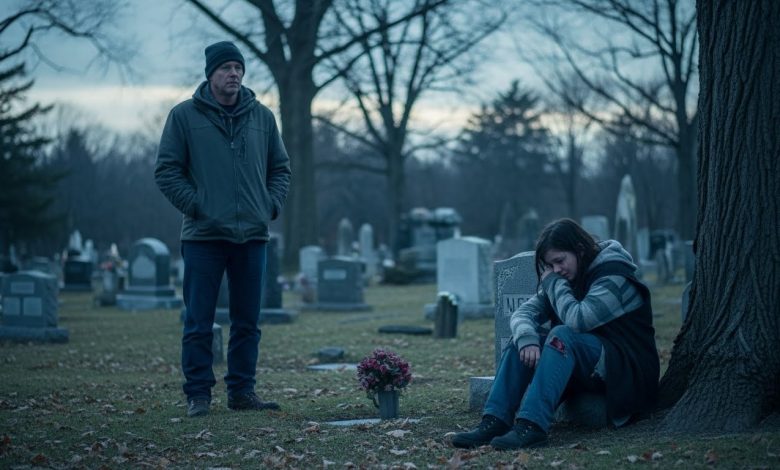
Walking gave my thoughts time to slow down. That was when I saw her. Someone was kneeling by my son’s grave.
Part 1. An Unexpected Presence
At first, anger surged through me. Oakwood was private. Quiet. Protected. No strangers came here by accident. And yet there she was. A young woman, wrapped in an oversized coat, her hair damp from the rain, her arms wrapped around the headstone as if she were clinging to someone still alive.
This was my place. My loss. My child. I approached quickly, my frustration spilling out before reason could stop it. “Excuse me,” I said sharply. “You can’t be here.” She didn’t jump. She didn’t run. Slowly, she lifted her head and looked at me.
And my breath caught in my throat. Her eyes. They were unmistakable. A rare shade of green, fractured with gold. Eyes I had memorized once. Eyes that belonged to my late wife.
Part 2. Two Words That Changed Everything
She looked exhausted. Thin. Young. No more than twenty. But there was something else in her expression. Familiarity. “I’m sorry,” she whispered. “I didn’t mean any harm.” I told myself it was coincidence. People share features. Grief makes you see ghosts. I asked her who she was.
She hesitated, then said two words so softly I almost missed them. “He’s my brother.” The world tilted.
My son had been an only child. That was what I had been told. What I had believed for over two decades. I demanded an explanation. Instead, she reached into her coat and pulled out an old photograph, creased and water-worn. A hospital room. A nurse holding two newborns.
One wrapped in blue. One in pink. On the back, in handwriting I would recognize anywhere, were words written by my wife. My twins. Please keep them safe.
Part 3. The Daughter
I Never Knew Her name was Emma. She told me she had grown up moving between foster homes, shelters, and streets. She had never known where she came from, only that she never quite belonged anywhere.
The photograph had been the only thing she carried through all of it. She hadn’t come looking for money. She hadn’t come looking for answers.
She had come to say happy birthday to the brother she never met. Standing there in the rain, I felt something break open inside me. Grief layered over grief. Shock layered over regret. I didn’t argue. I didn’t accuse. I brought her home.
Part 4. Searching for the Truth
Over the next few days, pieces began to fall into place. Medical records. Old files. Dates that didn’t align as cleanly as I once believed. Conversations that had ended too quickly when I was drowning in loss. DNA confirmed what my heart already knew. Emma was my daughter.
The system had failed her. People had made decisions without my knowledge, without my consent, and without regard for the life they were separating. There was no dramatic confrontation. No chase. No violence. Just the slow, devastating realization that silence and convenience had stolen twenty years from both of us.
Part 5. Learning Each Other
Healing didn’t happen overnight. Emma was cautious. She flinched at kindness. She questioned generosity. She waited for doors to close again. I learned how to be patient.
How to listen instead of fix. How to sit with discomfort without trying to erase it. We talked for hours. About my son. About her childhood. About my wife, Eleanor.
They shared the same love of art, the same quiet way of observing the world. In time, the house felt less empty.
Part 6. Returning to the Grave
Months later, we returned to Oakwood together. The rain had stopped. Sunlight filtered through the trees. Emma knelt where she had knelt before, but this time, she wasn’t alone.
She placed flowers beside the headstone. “Hi,” she whispered. “I found Dad.” I stood back, letting the moment belong to her. Grief was still there. But it no longer stood alone.
Part 7. What Remains
People often think closure means forgetting. It doesn’t. It means understanding. I didn’t lose one child. I lost two lives worth of time. But I gained something too.
A daughter who survived. A truth that finally surfaced. And a reminder that even after the longest silence, love can still find its way home.
Read more stories
- When Ella Langley Sang and Riley Green Simply Listened: Country Music’s Quietest Power, A Lesson in Musical Connection
- Turning 13 Years of Life into One Album Cover: More Than Just Music, A Touch of Tenderness
- The CMA Fest Moment Nobody Saw Coming: Riley Green and Carly Pearce’s Unforgettable Duet, The Power of Connection in Country Music
- The Osborne Brothers’ “Rocky Top” Becomes a Country Anthem That Bridged Generations and Redefined Bluegrass in 1967-2