The Principal Dismissed My Son’s Pain. She Didn’t Realize Someone Was Watching Who Believed in Quiet Justice.
Rain has a way of making everything feel heavier. The drive to school that morning felt longer than usual. The windshield wipers moved back and forth in a steady rhythm while my thoughts raced ahead to the day I knew would be difficult.
My son Leo sat in the backseat, bundled in a jacket that was still a little too big for him. He was quiet, staring out the window, conserving energy the way children do when they’ve learned that every day requires effort. “Do you have everything?” I asked gently. He nodded. “Yes, Mom.”
I wanted to say more. I wanted to promise things I couldn’t guarantee. So instead, I smiled and watched him walk toward the school doors, shoulders slightly hunched, blending into the crowd.
Chapter 1. The Space Some Children Learn to Take
Leo was smaller than most kids his age. Not just in size, but in presence. He had learned to move carefully, to avoid attention, to stay out of the way. It wasn’t something anyone taught him directly. It was something he absorbed over time.
At pickup that afternoon, I waited by the fence, as I always did. Parents stood in clusters, talking about vacations, schedules, and plans that assumed security as a given. Across the walkway sat an older man on a bench. He was there most days. Quiet. Unassuming.
People rarely looked at him for more than a second. He simply watched the world pass by, hands folded, eyes alert. I nodded to him out of habit. He nodded back.
Chapter 2. When Laughter Replaces Listening
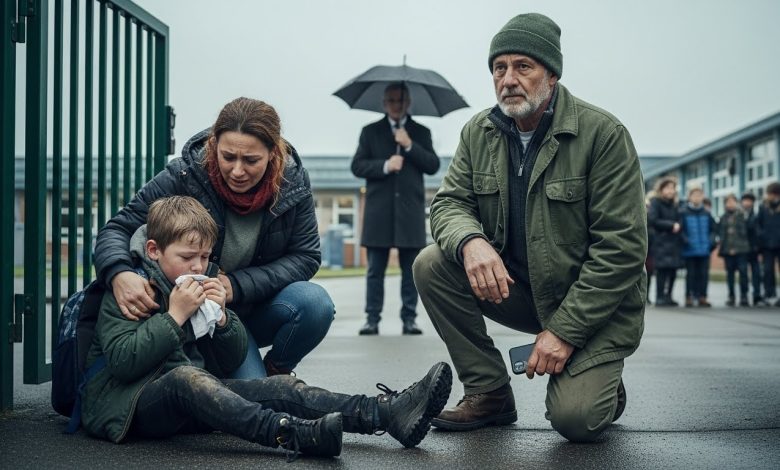
The bell rang and children poured out. I spotted Leo immediately. He walked carefully, keeping to the edge, eyes down. A group of boys nearby laughed loudly, blocking his path. I saw the hesitation. The pause that comes when a child weighs whether it’s safer to speak or stay silent.
There was a moment of confusion. Raised voices. Someone bumped into him. He lost his balance and fell into a shallow patch of wet ground near the curb. It wasn’t dramatic.
But it was humiliating. The laughter that followed was. I rushed forward, helping him up, brushing dirt from his sleeves. His face burned red, not from pain, but from being seen in the wrong way.
Chapter 3. Authority Without Compassion
The school principal approached, umbrella overhead, expression impatient. “What seems to be the problem?” she asked. “He fell because other students were blocking him,” I said calmly. “He’s been having a hard time lately.” She sighed. “Children need to learn resilience.
We can’t intervene in every minor incident.” I looked at my son, who stood silently beside me, gripping his backpack straps. “This wasn’t minor to him,” I said. The principal glanced at him briefly, then back at her watch. “Let’s not make this bigger than it is.” And just like that, she walked away.
Chapter 4. The Moment Someone Else Spoke
“Excuse me.” The voice was calm. Firm. I turned to see the older man from the bench standing nearby. He didn’t raise his voice. He didn’t accuse anyone. He simply addressed the principal with a level of composure that made her stop. “I’ve been sitting here for weeks,” he said. “Watching how some children are treated.
And how others are ignored.” The principal stiffened. “Sir, this is school business.” He nodded. “That’s exactly why I’m concerned.” He knelt slightly to Leo’s level. “Are you okay, son?” Leo nodded, surprised. “That matters,” the man said, standing again. “It should matter to everyone.”
Chapter 5. Quiet Accountability
The atmosphere shifted. Other parents had stopped talking. They were listening now. The principal straightened. “Sir, if you have concerns, you can contact the district.” “I already have,” he replied evenly. “Multiple times. With dates.
Observations. Patterns.” Her confidence faltered. “I believe leadership is measured not by convenience,” he continued, “but by how it treats those who are easiest to overlook.” No threats. No spectacle. Just truth, spoken clearly.
Chapter 6. The Days That Followed
Change didn’t come with sirens or headlines. It came quietly. Meetings were scheduled. Policies were reviewed. Parents were asked to share concerns they had once kept to themselves.
The principal was reassigned. A new interim administrator arrived. One who listened. Leo was offered support instead of dismissal. Understanding instead of tolerance.
Chapter 7. The Man on the Bench
A week later, I saw the older man again. “Thank you,” I said simply. He smiled. “You didn’t need me.
You just needed someone to echo what you already knew.” Leo tugged at my sleeve. “He helped me, Mom.” “Yes,” I said. “He did.” The man nodded once and returned to his bench.
Epilogue. What Power Really Looks Like
Power isn’t always loud. Sometimes it looks like someone paying attention. Sometimes it looks like refusing to look away. Sometimes it looks like dignity, offered without expectation.
My son still has hard days. But now he knows something he didn’t before: That he deserves to be seen. And sometimes, all it takes is one person quietly watching — and choosing to speak.
Read more stories
- When Ella Langley Sang and Riley Green Simply Listened: Country Music’s Quietest Power, A Lesson in Musical Connection
- Turning 13 Years of Life into One Album Cover: More Than Just Music, A Touch of Tenderness
- The CMA Fest Moment Nobody Saw Coming: Riley Green and Carly Pearce’s Unforgettable Duet, The Power of Connection in Country Music
- The Osborne Brothers’ “Rocky Top” Becomes a Country Anthem That Bridged Generations and Redefined Bluegrass in 1967-2