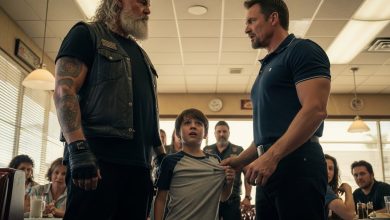
A Boy’s Lunch Was Thrown Away for Laughs. One Adult Chose to Do Something Different.

Chapter 1. The Lunch That Meant Everything
I was ten years old when I learned that lunch wasn’t just food. It was proof. Proof that my mom had made it through another week of double shifts.
Proof that we were still holding on, even when the fridge was almost empty and the envelopes on the counter said things like FINAL NOTICE.
That morning, she scraped the last of yesterday’s dinner into a faded plastic container.
The lid didn’t close right unless you pressed it down hard. “It’s not much,” she said quietly. “But it’s yours.” I nodded and smiled, even though my stomach was already tight with worry.
At school, I sat where I always sat. Near the trash cans. If you sit close to the trash, people don’t look at your food too closely. That was the plan.
Chapter 2. When Hunger Becomes Entertainment
I hadn’t taken my first bite yet when I heard the voice.
“Well, that’s depressing.” Brad. He was older, bigger, and surrounded by kids who laughed before he finished speaking. His shoes cost more than our rent. “What is that?” he said, leaning over my table. “Leftovers from the trash?”
I tried to close the container. He slapped it out of my hands. It hit the floor. Food spilled everywhere. The cafeteria laughed. Not everyone. But enough. I stared at the mess.
My chest burned. I thought about my mom’s hands that morning, cracked and tired. And now it was gone.
Chapter 3. Cleaning What Wasn’t Mine to Clean
I knelt down and started wiping it up.
Not because I was told to. Because that’s what you do when you’re poor. You clean the mess, even when someone else made it.
Brad laughed louder. “Look at him,” he said. “Practicing for his future.” That’s when the room changed.
Chapter 4. The Man Who Didn’t Yell
A chair scraped behind me. A man I didn’t know stood up. He wasn’t loud. He wasn’t angry.
He just walked over and knelt beside me. “Hey,” he said gently.
You don’t have to do that.” I looked up, confused. He turned to Brad. Not aggressively. Calmly. “You threw it,” he said. “So you’ll help clean it.” Brad scoffed. “Who are you?”
“Someone who doesn’t laugh at hunger,” the man replied. The room went quiet.
Chapter 5. Accountability Without Fear
Brad hesitated. The man didn’t threaten him. Didn’t raise his voice.
He just waited. Slowly, painfully, Brad knelt down and helped clean the mess.
Everyone watched. No one laughed now.
When it was done, Brad muttered an apology. It wasn’t perfect. But it was real.
Chapter 6. A Meal Shared
The man led me to his table.
“Sit,” he said. “Eat.” I shook my head. “I can’t.” “You can,” he said. “And you will.”
He shared his lunch with me. No speeches. No pity. Just food.
Chapter 7. What He Told Me Quietly
“When I was your age,” he said, “I was hungry too. People forget what that feels like.”
I nodded, mouth full, trying not to cry. “You didn’t do anything wrong,” he added.
“And you don’t deserve to be embarrassed for surviving.” No one had ever said that to me before.
Chapter 8. What Changed After
The school addressed it later. Adults talked. Policies were mentioned.
But the real change happened in that moment. People saw. Brad didn’t bother me again.
Not because he was scared.
Because he was exposed.
Epilogue.What I Carry With Me
I don’t remember what happened in math class that year. I remember that lunch. Not because it was taken from me. But because someone chose dignity over silence.
Sometimes justice isn’t loud. Sometimes it just kneels beside you and says, “You matter.”
Read more stories
- When Ella Langley Sang and Riley Green Simply Listened: Country Music’s Quietest Power, A Lesson in Musical Connection
- Turning 13 Years of Life into One Album Cover: More Than Just Music, A Touch of Tenderness
- The CMA Fest Moment Nobody Saw Coming: Riley Green and Carly Pearce’s Unforgettable Duet, The Power of Connection in Country Music
- The Osborne Brothers’ “Rocky Top” Becomes a Country Anthem That Bridged Generations and Redefined Bluegrass in 1967-2