They Dumped a Bucket of Dirty Mop Water on Me in the Cafeteria and Called Me “Trash”. Their Laughter Died the Moment My Father Walked In
This fictional story is written to raise awareness about bullying, abuse of power, and accountability. It avoids graphic detail and focuses on dignity, truth, and emotional resilience.
The smell reached me before the cold ever did.
Bleach. Old ammonia. Sour milk.
I was sitting at the corner table of the Eastwood High cafeteria, doing what I had learned to do best — staying small. Head down. Eyes on my sandwich. No sudden movements.
If I followed the rules, maybe Jax and his friends would leave me alone.
They didn’t.
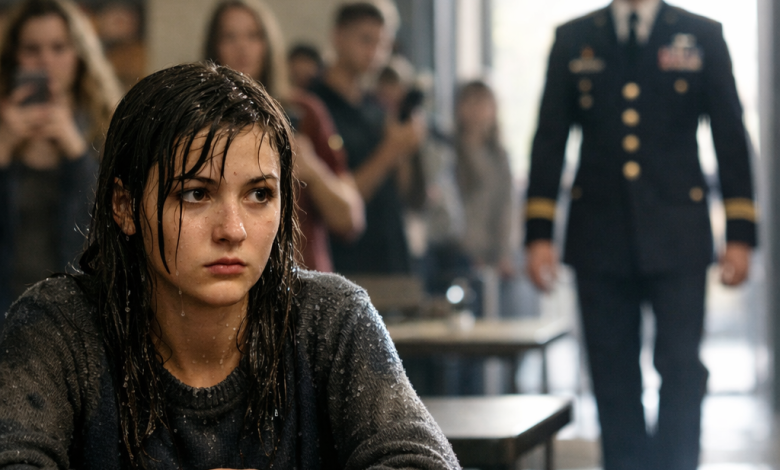
One second I was chewing, staring at the cracked tile floor. The next, my world turned heavy and freezing.
A bucket of filthy mop water crashed over my head.
I gasped as the icy liquid soaked my hair, my sweater, my shoes. Grey water dripped down my face, carrying the sharp sting of chemicals and something sour I didn’t want to think about.
“Oops,” Jax said loudly. “Wrong place.”
The cafeteria erupted.
Not just laughter. A roar.
Hundreds of faces turned toward me. Fingers pointed. Phones were raised. Someone shouted something I couldn’t fully hear over the noise.
I sat there, shaking, unable to move. The cold made my teeth chatter. The humiliation pressed down on me like weight.
Jax leaned close enough that I could smell his cologne.
“You don’t belong here,” he whispered. “Everyone knows it.”
He kicked my chair, sending me off balance and down onto the wet floor.
The laughter grew louder.
I closed my eyes.
All I wanted was to go home.
Chapter 2: What They Didn’t Know
My father had been gone for months.
He thought this school was safe. He thought teachers watched. He thought things like this didn’t happen.
I never told him.
Then the noise stopped.
Not faded.
Stopped.
The double doors at the far end of the cafeteria opened, and light spilled across the floor.
Footsteps followed. Slow. Measured.
I wiped my eyes and looked up.
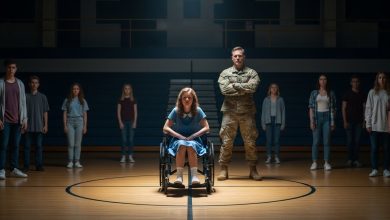
My father stood in the doorway.
He wasn’t wearing everyday clothes. He wore a formal uniform, neat and composed, the kind that made people straighten without knowing why.
He didn’t rush. He didn’t raise his voice.
He walked forward.
The crowd parted instinctively.
He stopped in front of me and looked down at the soaked sweater, the spilled food, the puddle around me.
Then he looked up.
Chapter 3: Silence
“Phones away,” he said calmly.
Not loud. Not angry.
Every phone lowered.
He turned toward Jax.
“Who did this?”
No one answered.
The silence stretched.
Finally, Jax spoke, his voice unsteady. “It was just a joke.”
My father nodded once.
“Then we’ll treat it seriously,” he said.
He helped me to my feet and placed his jacket around my shoulders.
“You’re not in trouble,” he whispered. “I’ve got you.”
Chapter 4: What Followed
Teachers arrived. Administrators followed.
Questions were asked.
Videos appeared.
What was supposed to be forgotten couldn’t be erased.
The story spread — not because of shouting, but because of proof.
And because someone finally stood beside me.
Epilogue: Going Home
That afternoon, we didn’t talk much.
We just walked out together.
For the first time in a long while, I wasn’t invisible.
I wasn’t “trash.”
I was someone’s daughter.
Read more stories
- When Ella Langley Sang and Riley Green Simply Listened: Country Music’s Quietest Power, A Lesson in Musical Connection
- Turning 13 Years of Life into One Album Cover: More Than Just Music, A Touch of Tenderness
- The CMA Fest Moment Nobody Saw Coming: Riley Green and Carly Pearce’s Unforgettable Duet, The Power of Connection in Country Music
- The Osborne Brothers’ “Rocky Top” Becomes a Country Anthem That Bridged Generations and Redefined Bluegrass in 1967-2