The Dog on the Rug Who Made a Town Choose Kindness or Comfort
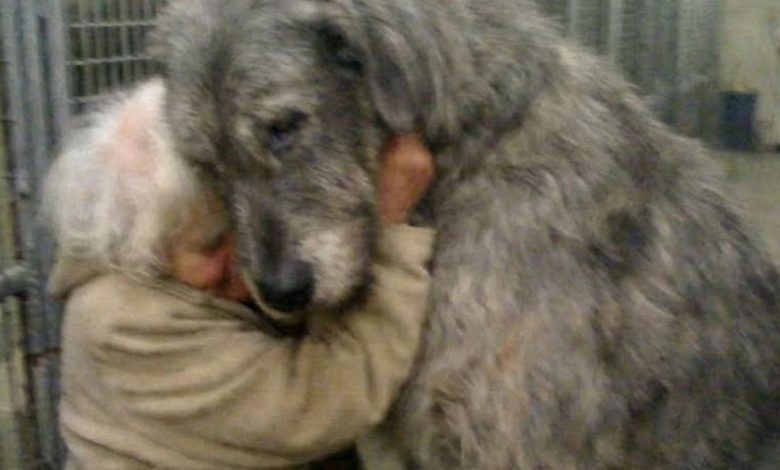
The shelter manager tapped the clipboard with a red pen, refusing to meet my eyes. “Ma’am, you don’t want Cage 4. He’s massive, he’s nine years old, and he can barely stand. You aren’t adopting a pet; you’re adopting a funeral.”
I signed the papers anyway.
“I’m seventy-three,” I told him, taking the leash. “I know a thing or two about being written off before your expiration date.”
That was how I met Barnaby.
Barnaby is an Irish Wolfhound, which is a polite way of saying he’s a small horse made of gray, scruffy carpet. He weighs 150 pounds. He smells permanently like old wool and rain. When he walks, it sounds like a tired drumbeat—thump, drag, thump.
My son, Mark, the lawyer, nearly had an aneurysm when he visited my bookstore and saw a creature the size of a sofa blocking the Philosophy section.
“Mom,” he whispered, pinching the bridge of his nose. “This is a liability. What if he bites a customer? What if he dies in the lobby? This is a business, not a nursing home.”
“Barnaby doesn’t bite, Mark,” I said, stepping over the dog’s massive paws to restock a shelf. “He’s too tired to bite. And he’s not a liability. He’s the manager.”
I was lying, of course. I didn’t know what Barnaby was. For the first two weeks, he just slept on the rug near the radiator. He breathed like a rusty accordion. I wondered, late at night, if the shelter manager was right. Had I just brought a tragedy into my shop?
Then, the Tuesday Morning Book Club happened.
It was usually a quiet affair, but that day, a young mother came in with her son, Leo. Leo is ten. He has a severe stutter and anxiety that makes him shake like a leaf in a storm. He usually sits in the corner, clutching a comic book, terrified that someone might ask him a question.
Barnaby was asleep. Leo tripped over his own shoelaces and landed with a thud right next to the dog’s flank.
I froze. Mark’s voice echoed in my head: Liability.
Barnaby lifted his massive, shaggy head. He looked at the terrified boy. He didn’t bark. He didn’t growl. He simply let out a long, heavy sigh, shifted his weight, and laid his chin directly on Leo’s trembling leg.
Leo went still. He stared at the giant creature pinning him down with pure, heavy affection.
Slowly, Leo’s hand reached out and buried itself in the coarse gray fur. The shaking stopped.
“H-he… he likes me,” Leo whispered.
“He loves you,” I said softly from the counter.
Leo opened his book. For the next hour, he read aloud to the dog. He stumbled, he paused, but he didn’t quit. Barnaby didn’t correct him. Barnaby didn’t check a watch. Barnaby just offered the one thing humans are terrible at giving: absolute, unhurried presence.
After that, the atmosphere in “The Turning Page” shifted.
Barnaby wasn’t just a dog. He became a destination.
People didn’t come for the bestsellers. They came for the “Confessional.” That’s what I call the rug where Barnaby sleeps.
I’ve seen a corporate executive in a three-thousand-dollar suit sit on the dirty floor, loosening his tie, scratching Barnaby’s ears while tears ran down his face. I didn’t ask why. Barnaby didn’t ask why.
I’ve seen the teenage girl with the purple hair and the scars on her arms sit with him for hours, just breathing in rhythm with his slow, rattling lungs.
One afternoon, a tourist complained. “That dog takes up the whole aisle,” he grumbled. “And he looks like he’s on his last legs. Why invest in something that’s going to be gone in six months?”
I put down the stack of invoices I was holding.
“Because,” I told him, “he knows something you don’t.”
The man scoffed. “And what is that?”
“He knows that the value of a life isn’t measured in how much time you have left,” I said. “It’s measured in how much love you can hold right now.”
Barnaby is slow. It takes him five minutes to stand up. His hips are bad. I spend a fortune on his joint supplements—money I should probably be saving for roof repairs.
But every morning, when I unlock the front door, he is there. He greets every customer not with energy, but with acceptance. In a world that screams at us to be faster, younger, prettier, and richer, Barnaby is a 150-pound anchor that says: It is okay to just be.
He teaches me that we are not defined by our utility. We are not “useless” when we can no longer run fast or work hard.
My son called yesterday. “Mom,” he said, sounding awkward. “Can I… can I bring the kids over this weekend? They want to see the giant dog. And… actually, I had a rough week. I think I need to see him, too.”
I looked down at Barnaby. He was snoring, his paws twitching, chasing rabbits in a dream he was too old to catch in real life.
We are all just walking each other home. Some of us just have four legs and a little less time to do it.
So, please. The next time you pass a shelter, don’t just look for the puppies. Don’t look for the ones jumping at the gate, begging for attention.
Look in the back. Look for the gray muzzle. Look for the one sleeping in the corner, the one everyone says is “too old” to matter.
Love doesn’t have an expiration date. And sometimes, the oldest hearts have the most room to let you in.
PART 2 — The Quiet Dog, The Loud World
Three days after I taped a handwritten note to the front counter that said LOVE DOESN’T HAVE AN EXPIRATION DATE, someone tried to take Barnaby away.
I’m telling you this up front so you understand what kind of week it was.
If you’re new here, I’m the seventy-three-year-old woman who owns a small used bookstore called The Turning Page, and Barnaby is the nine-year-old Irish Wolfhound I adopted from the shelter—the one who walks like a tired drumbeat and sleeps like a collapsed sofa on the rug by the radiator.
He doesn’t fetch. He doesn’t do tricks. He doesn’t “work” in the way people like my son, Mark, define work.
He just exists with a kind of slow honesty that makes people sit down on the floor and exhale for the first time in months.
And apparently… that’s controversial.
It started with a letter.
Not an angry email. Not a review. Not a vague social media post written by someone who’s never read a book longer than a menu.
A real letter, in a pale envelope, stamped and official-looking, slid halfway under my shop door before sunrise.
Barnaby watched me pick it up.
He was standing—barely—his hind legs wobbling the way they always do in the mornings. His head hung low, his gray eyebrows giving him that permanent look of mild disappointment, like a granddad watching you microwave soup instead of making it from scratch.
I slit the envelope with my thumbnail.
The paper inside smelled like toner and power.
NOTICE OF COMPLIANCE VISIT it read in bold, tidy letters.
There had been a complaint about “an animal regularly occupying a public retail space.”
A compliance officer would be arriving Thursday at 10:00 a.m. to “assess safety, sanitation, and accessibility.”
I read that sentence three times, because the words were polite but the message wasn’t.
Move the dog. Or else.
Mark called me ten minutes after I texted him a photo of the letter.
He didn’t say hello.
He said, “Mom. Please tell me this is a joke.”
“I don’t joke about letters with bold fonts,” I told him.
I could hear him breathing like he was trying to keep his blood pressure from bursting through his ears.
“This is exactly what I warned you about,” he said. “All it takes is one person to get mad, one person to claim—anything. Allergies. Fear. Injury. You are running a business.”
“I am running a bookstore,” I corrected. “Not a courtroom.”
“Same thing,” he snapped, then softened immediately, because Mark is not heartless. He’s just trained to anticipate disaster for a living. “Mom… if the city makes an issue out of this, it gets complicated. Fines. Orders. Paperwork. And if something happens—anything—”
“Barnaby hasn’t hurt anyone.”
“That’s not how liability works,” he said quietly. “It’s not about what he is. It’s about what people say he is.”
I looked down.
Barnaby had lowered himself to the rug again, with that slow, deliberate collapse like a building being demolished in reverse. His chest rose and fell. Rusty accordion. Rain on old wool.
“People say a lot,” I murmured.
Mark hesitated.
“Do you want me to come down there?” he asked.
“No,” I said, too quickly.
Because if Mark came down here with his lawyer face on, he would start speaking in words like “risk management” and “best practices,” and by the end of the day I’d be standing alone in my bookstore staring at an empty rug.
And I wasn’t ready for that kind of quiet.
So I did what any sensible seventy-three-year-old woman with a stubborn streak and a giant dog would do.
I opened the shop.
By noon, the bookstore smelled like paper, cinnamon tea, damp coats, and the faint medicinal tang of Barnaby’s joint supplements crushed into his breakfast.
And by two, the rumor had spread.
People have a sixth sense for trouble. They can smell it through walls.
The first one to mention the letter wasn’t a customer.
It was Mina, my Tuesday Morning Book Club regular with the blunt bob haircut and the voice of someone who has argued with too many school boards in her life.
She marched up to the counter, slapped her tote bag down like a gavel, and said, “Who complained?”
“I don’t know,” I lied.
Mina’s eyes flicked to Barnaby. He opened one eyelid, assessed the threat level, and went back to sleep.
“You have a right to know,” she hissed. “This is ridiculous. He’s not a hazard. He’s… he’s a national treasure.”
“Mina,” I said, trying not to smile, “he drools into the History section.”
“History has survived worse,” she snapped.
Then she leaned in and lowered her voice.
“Is it that woman?” she asked.
“What woman?”
Mina made a face like she’d bitten into a lemon.
“The one who complains about everything,” she said. “The one who once tried to get the farmer’s market shut down because the carrots were ‘too dirty.’”
I sighed.
Every town has one of those.
In our town, her name was Denise Halpern.
Denise didn’t shop here much, because she once asked me if we had “more neutral books.” I asked what she meant. She said, “Books that don’t push an agenda.”
I told her literature is, by nature, an agenda: it pushes you to feel something you didn’t plan to feel.
Denise didn’t like that.
She also didn’t like noise, youth, dogs, strollers, public laughter, or anything that wasn’t perfectly predictable.
So yes—if someone was going to file a complaint about a dying dog quietly sleeping on a rug… Denise was an excellent guess.
But guesses don’t help you when an official letter is already under your door.
That night, after I locked up and turned off the main lights, I sat on the rug beside Barnaby.
The bookstore looked different in the dark.
Daylight makes everything look practical. Night makes everything look like a memory.
Barnaby’s fur glowed faintly gray in the lamplight. His breath was slow, uneven, but steady. I stroked the ridge of his shoulder, feeling the bone under the shag.
“Thursday,” I whispered. “We have an appointment, you and me.”
Barnaby’s ear flicked.
I don’t know if he understood. He probably didn’t.
But he shifted his massive head—just a little—and pressed the side of it into my lap.
One hundred and fifty pounds of trust.
And I felt something in my chest tighten, the way it does when you realize you love something you cannot protect from time.
Read more stories
- When Ella Langley Sang and Riley Green Simply Listened: Country Music’s Quietest Power, A Lesson in Musical Connection
- Turning 13 Years of Life into One Album Cover: More Than Just Music, A Touch of Tenderness
- The CMA Fest Moment Nobody Saw Coming: Riley Green and Carly Pearce’s Unforgettable Duet, The Power of Connection in Country Music
- The Osborne Brothers’ “Rocky Top” Becomes a Country Anthem That Bridged Generations and Redefined Bluegrass in 1967-2



Great story, I’m interested in hearing the remainder of the story. It is great