He was only 21, a young farm boy from Utah with no wealth, no influential supporters, and

He was only 21, a young farm boy from Utah with no wealth, no influential supporters, and no engineering degree. What he possessed was a vision he had nurtured since he was fourteen, inspired by observing the neat rows of a plow carving through his family’s land. That vision lingered in his mind, the thought that an image could be transmitted similarly, line by line.
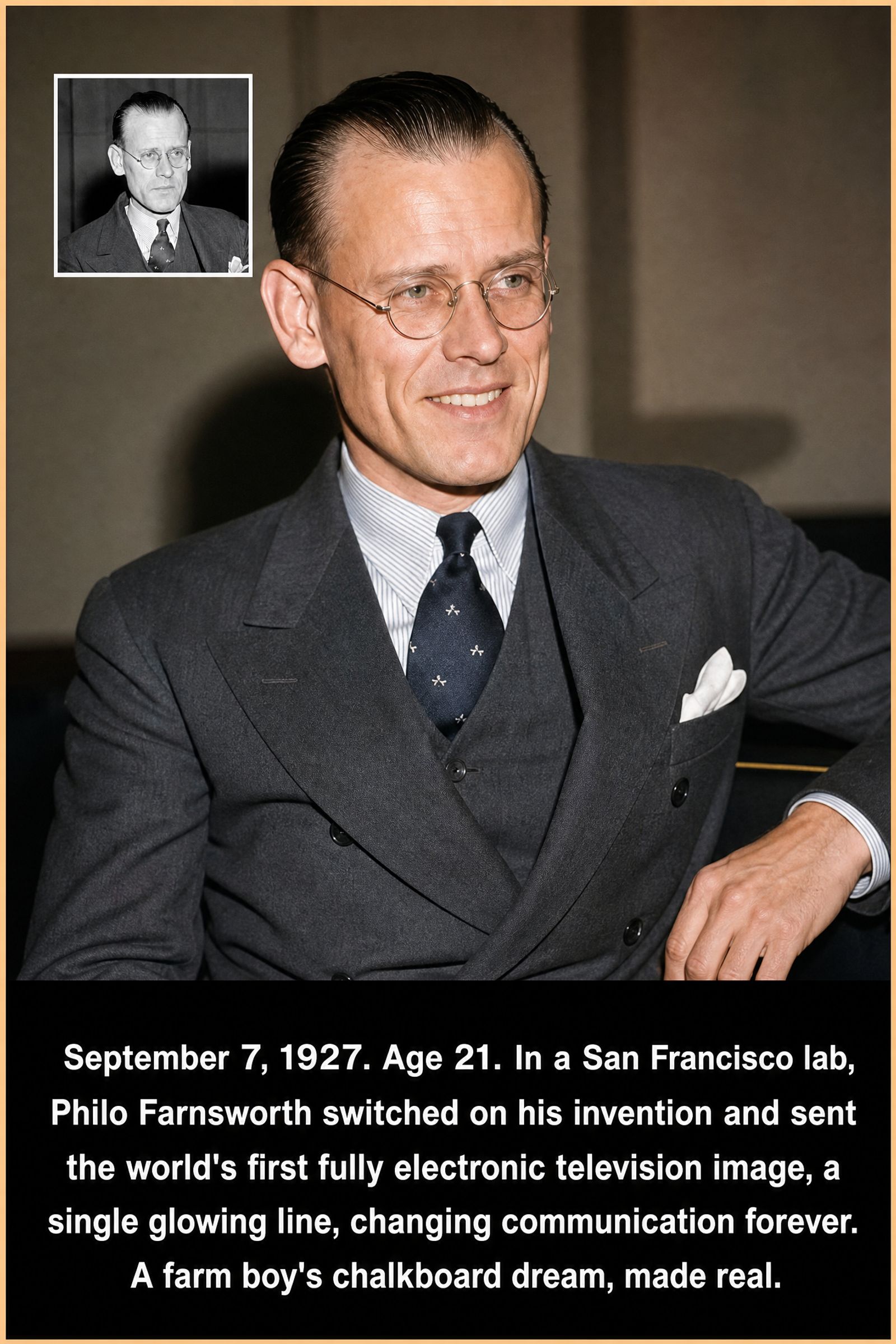
In a modest lab on Green Street in San Francisco, Farnsworth powered on his creation. On the receiving screen, a solitary glowing line emerged. It was basic. It was tiny. But it was real. For the first time in human history, an image was entirely sent through electronics—no spinning disks, no mechanical components, just pure electricity delivering sight itself.
He turned to his astonished team and proclaimed the words that signified the true inception of television: “There you are, electronic television.” A teenager’s chalkboard drawings had transformed into reality, an invention that would forever change how the world sees, learns, and connects.
Read more stories
- Linda Ronstadt’s “Blue Bayou” Redefined Pop-Country Crossovers and Cemented Her Legacy in 1977-2
- This Innocent Looking Boy Grew Up To Become One Of The World’s Most Evil Men
- A 22-year-old soldier crawled through jungle fire to rescue the men beside him and never m
- Roy Wilkins was born in St. Louis in 1901 and grew up in St. Paul, Minnesota, after losing