My Daughter Secretly Recorded What My Husband Did in the Shed—And That Video Finally Exposed the Truth
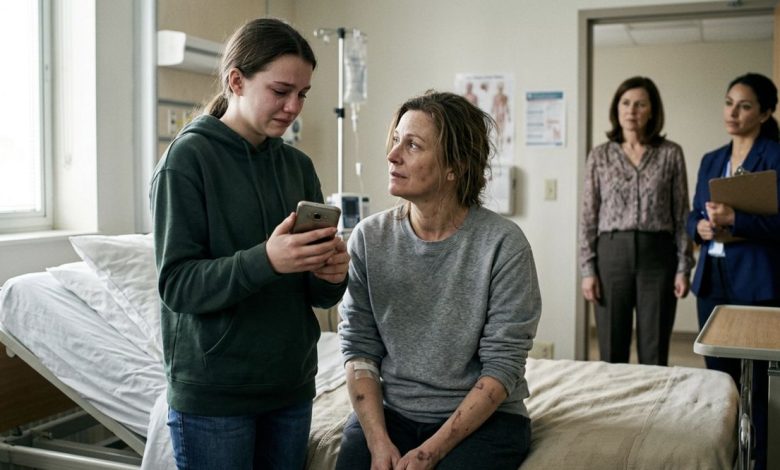
I closed my eyes. The room seemed to tilt. They had already prepared the lie. Not after. Before. They had discussed what they would say while I was still lying on the shed floor.
My sister reached over and took the phone from my hand. “There’s more.”
I shook my head. “I don’t want to hear it.”
“Yes,” she said gently. “You do.”
I opened my eyes. She turned the volume up. The recording crackled. My mother-in-law laughed. “If she goes to the police, who’s going to believe her? She’s been in that house for years. People will think she’s trying to destroy the family.”
My husband answered, “She won’t go.”
“How do you know?”
“Because she never does.”
Those five words hurt more than I expected. Because he was right. For years, I had stayed silent. Not because I didn’t know what was happening. Because I believed silence could protect my children. I thought if I endured one more argument, one more insult, one more frightening night, maybe the children would grow up and leave the house safely. I thought keeping the family together was the same thing as protecting the family. But sitting in that hospital bed, listening to my husband confidently explain why I would never speak, I realized something. My silence had not protected anyone. It had taught him that there would never be consequences.
My sister leaned closer. “There’s another part.”
I looked at her. “What?”
She hesitated. “Your daughter recorded something from earlier.”
I turned toward my youngest. She was crying now. “You knew?”
She wiped her cheeks quickly. “I didn’t know if it would help.”
“It helped,” my sister said.
My daughter finally looked at me. “I was scared.”
I reached for her hand. “So was I.”
Her fingers closed around mine. “But you still did it.”
She nodded. That was when the nurse returned. She looked at my sister, then at my daughter, then at me. “Your doctor wants to speak with you.”
My sister stood immediately. “Is my sister being discharged?”
The nurse shook her head. “No. She’s staying.”
I felt something inside me loosen. Staying meant I did not have to return home. Not tonight. Maybe not tomorrow. Maybe not ever.
The doctor came in a few minutes later with a social worker. The social worker sat beside my bed and introduced herself. She did not ask why I stayed. She did not ask why I didn’t leave sooner. She did not say, “Why didn’t you tell someone?” Instead, she asked one question. “Do you feel safe going back to your home?”
I stared at the blanket. “No.” The word came out almost soundlessly. But once it was spoken, it could not be taken back. “No,” I repeated.
My sister squeezed my shoulder. The social worker nodded. “Then we will work from there.”
For the first time in years, someone did not ask me to explain why I deserved safety. They simply started helping me find it.
That night, my husband called. His name appeared on the hospital phone. My entire body stiffened. My sister reached for the phone. “Don’t answer.”
I stared at the screen. It stopped. Then it rang again. And again. Then a message appeared. We need to talk. You are making this much bigger than it is.
My sister read it. She looked at me. “Do you want to respond?”
I shook my head. Another message arrived. Your mother is extremely upset. Then: Think about the children before you destroy this family.
I stared at those words. The same man who had tied my hands to a wooden beam was now using the children as a weapon. My sister took a screenshot. “Keep everything.” She created a folder on her phone. “Messages. Calls. Photos. Medical records. Everything.”
I nodded. Then another message arrived. This one was different. If you tell anyone what happened, you’ll regret it.
My sister’s expression hardened. “That one stays.”
The social worker saw it. She immediately documented it. And suddenly, something changed. The story wasn’t just my word against his anymore. There was a recording. There were medical findings. There were photographs. There were messages. And there was my daughter. A child who had been forced to become a witness because the adults around her had failed to protect her.
I looked at her. “I am sorry.”
She shook her head. “Don’t say sorry.”
“What should I say?”
She swallowed. “Say we’re not going back.”
My heart broke. But this time, not from fear. From determination. “We’re not going back.”
The next morning, detectives came to the hospital. I expected them to be cold. Instead, the woman who spoke with me pulled a chair close to the bed. She explained that I could stop at any time. She asked whether I wanted my sister present. “Yes.” Whether I wanted my daughter present. “No.”
She nodded. “Then she doesn’t need to hear this.”
I almost cried. It was such a simple sentence. Yet nobody in my house had ever respected a boundary so easily. The detective listened. She wrote things down. She asked about the shed. The rope. My husband’s actions. My mother-in-law’s presence. The previous injuries. The threats. The recording.
When I finished, she closed her notebook. “Your daughter did something very important.”
I looked down. “She was scared.”
“She was brave.”
I shook my head. “She shouldn’t have needed to be brave.”
The detective’s expression softened. “No. She shouldn’t have.”
That sentence stayed with me. Because it was the first time someone had said exactly what I had been unable to admit. My daughter should have been worried about homework. Friends. Music. School. Not about secretly recording violence in a shed. Not about learning which footsteps meant danger. Not about deciding which adult could be trusted. I realized then that leaving wasn’t only about saving myself. It was about giving my children back the childhood I had watched disappear.
By afternoon, my husband arrived at the hospital. Security stopped him at the entrance. He argued. He demanded to see me. He told them he was my husband. Then my mother-in-law arrived. She made even more noise. “This is a family matter!”
A security guard calmly told her she could not enter without authorization. My husband shouted my name from the hallway. I heard him from my room. For years, that voice had controlled the temperature of the entire house. One shout could make everyone stop eating. One slammed door could send the children into their rooms. One angry sentence could ruin an entire weekend. But now? He was on the other side of a locked hospital door. And I was not alone.
My sister stood beside me. The social worker stood nearby. A nurse was at the doorway. And for the first time, his anger had nowhere to land. Then I heard him say something I never expected. “She belongs to me!”
My sister looked at me. I looked back. And something inside me finally died. Not my courage. Not my hope. The belief that I owed him anything. The nurse closed the door. The shouting faded. And I whispered, “No.”
My sister heard me. “What?”
I looked toward the door. “She doesn’t.”
My sister smiled through her tears. “No.” She corrected me gently. “She belongs to herself.”
I closed my eyes. And for the first time in years, I believed it.
Three days later, the hospital released me to a temporary safe location arranged through my sister. I walked out wearing borrowed clothes. Everything I owned was still in that house. My photographs. My winter coat. My wedding album. My children’s old drawings. The kitchen table where we had eaten thousands of meals. The bedroom where I had cried silently so nobody would hear. For a moment, I felt like I was leaving my entire life behind.
Then my daughter took my hand. “Mom?”
“Yes?”
“Are you sad?”
I looked at the hospital doors behind us. “Yes.”
She nodded. “Me too.” Then she squeezed my hand. “But we’re free.”
I stopped walking. Free. The word felt unfamiliar. Almost frightening. But beautiful. I hugged her. And for the first time, I allowed myself to cry without apologizing for it. We kept walking. Neither of us looked back. Not yet. Because there was still one thing left inside that house. The truth. And soon, my husband was going to discover that the woman he believed would never speak had finally found her voice.
The first night in my sister’s house, I couldn’t sleep. Every time the floor creaked, my eyes opened. Every time a car passed outside, my heart jumped. Every time I heard a man’s voice from the television downstairs, my body became tense before my mind could remind me that I was somewhere safe.
My sister noticed. She didn’t say anything at first. She simply left the hallway light on. Then she placed a glass of water beside my bed. “You don’t have to sleep,” she said quietly. “Just rest.”
I stared at the ceiling. “I don’t know how.”
She sat on the edge of the mattress. “You will.”
I wanted to believe her. But fear had lived inside me for so long that it felt less like an emotion and more like part of my body. My youngest daughter was sleeping in the next room. My other children were staying with relatives temporarily. For the first time in years, I could hear them breathing without wondering whether someone was going to slam a door. I closed my eyes. And then I remembered the shed. The rope. The wooden beam. My mother-in-law laughing. I opened my eyes again. My sister was still there.
“Why did I stay?” I whispered.
She didn’t answer immediately. Then she said, “Because he spent years convincing you that leaving would hurt everyone except him.”
I turned my face toward her. “He said the children needed a father.”
“He wanted you to believe that.”
“He said I would destroy the family.”
“He wanted you to believe that too.”
I swallowed. “And now?”
My sister looked at me. “Now he gets to discover what happens when the person carrying the whole family finally puts the weight down.”
The next morning, the detective called. She told me there had been developments. My husband’s attorney had contacted the authorities. He was claiming the recording had been taken out of context. He was saying my husband had only been trying to discipline me.
My stomach tightened. “Discipline?”
My sister’s face hardened. The detective continued. “He’s also saying your injuries happened because you are unstable and prone to accidents.”
I closed my eyes. There it was. The old story. The one they had practiced. The one my husband had already predicted.
My sister leaned toward me. “But they didn’t know about the hospital records.”
The detective paused. “And they didn’t know about the older medical documentation.”
I looked at her. “What documentation?”
“Your previous visits to the clinic.”
My heart stopped. I had forgotten about them. Three different visits over several years. A split lip. A badly bruised shoulder. A deep cut near my ribs. Each time, I had told the doctor I had fallen. Each time, the doctor had asked whether I felt safe at home. Each time, I had lied. But apparently, the medical records still existed. The detective said the injuries had been documented. So were my explanations. My lies were now evidence too. Not evidence against me. Evidence of how long I had been afraid.
That afternoon, my oldest daughter came to see me. She walked through the front door carrying a paper bag. The moment she saw me, she started crying. I opened my arms. She ran into them. “Mom.”
“I’m here.”
“I should have done something.”
I pulled away. “No.”
“But I knew.”
I looked at her. “How much?”
She wiped her cheeks. “Enough.” She sat beside me. “I used to hear you crying in the bathroom.”
My chest tightened. “I thought you were tired.”
“I knew you weren’t.”
I didn’t know what to say. She looked down at her hands. “I was angry at you.”
I nodded slowly. “You had every right.”
“No,” she said. “I was angry because I thought you chose him over us.”
That sentence cut deeper than anything else. “I never chose him over you.”
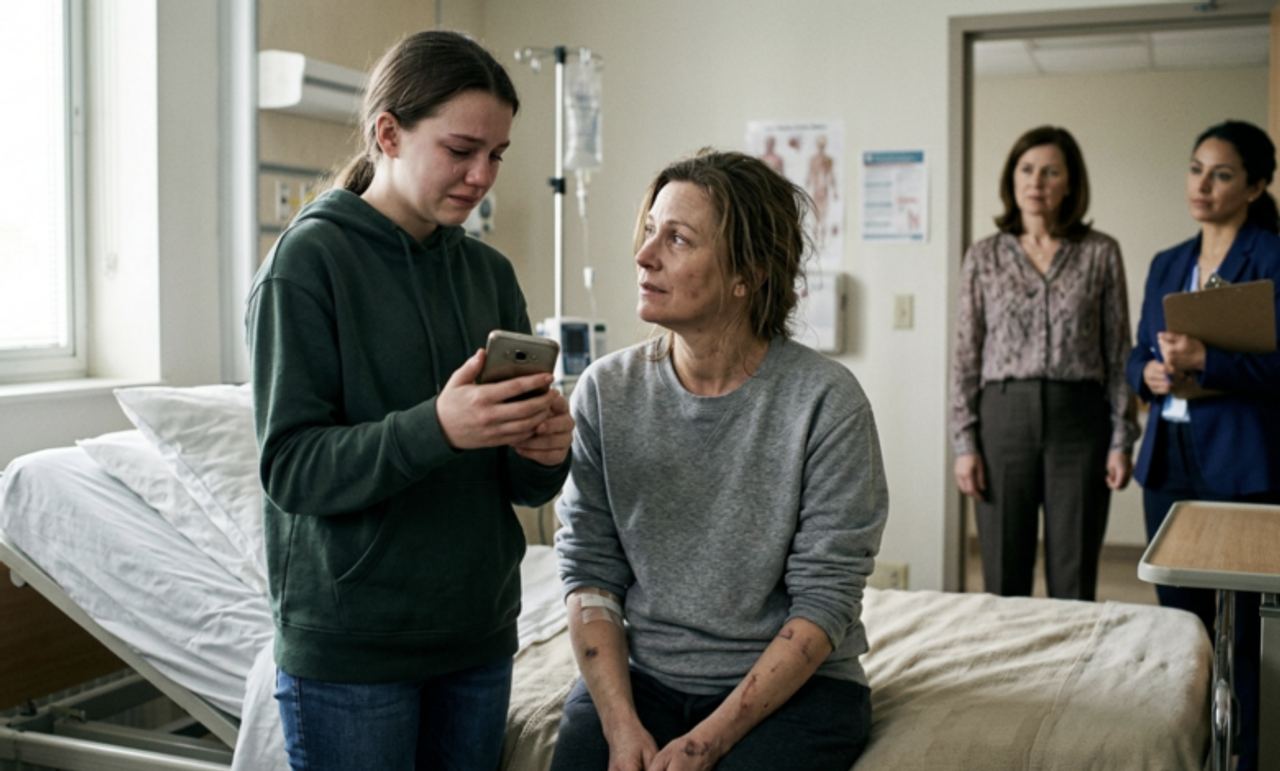
“I know that now.” She looked at me. “But when you’re a kid, you don’t understand why a mother stays.”
I couldn’t look at her. “I thought if I kept everyone calm, you would all be safe.”
She reached for my hand. “You were trying to survive.”
The words broke something open inside me. I cried. She cried. And for several minutes, neither of us tried to make the other feel better. We simply sat there and allowed the truth to exist.
Then she reached into her bag. “I brought something.” She handed me a small envelope. Inside was a photograph. It was old. Very old. A picture of all of us at the beach. The children were laughing. My husband was smiling. I was standing beside him. From the outside, we looked happy. Perfect, even.
My daughter pointed at me. “Do you remember that day?”
“Yes.”
“You spent the entire morning packing everyone’s food.”
I smiled faintly. “You complained because I made you wear sunscreen.”
She laughed. “I hated sunscreen.”
For a moment, we were just a family remembering a normal day. Then she turned the photograph over. On the back, she had written something. The family in this picture still exists. We just have to build it somewhere else.
I pressed the photograph against my chest.
A week later, I was asked to give a formal statement. This time, I didn’t hide anything. I told them about the first time my husband had hurt me. I told them how his mother had defended him. I told them how the violence became more frequent. I told them about the threats. The apologies. The gifts afterward. The promises. The way he would become gentle for a few days and then explode again. I told them how my mother-in-law would sometimes tell me I had provoked him. How she would tell me a good wife knew when to stay quiet. How she had laughed outside the shed. I told them everything.
And when I finished, the detective closed her notebook. “You’ve done something difficult.”
I looked at her. “What?”
“You’ve stopped protecting the people who hurt you.”
I stared at the table. That was exactly what I had done. For years, I had thought loyalty meant protecting family secrets. Now I understood something different. There is a difference between protecting a family and protecting the person destroying it.
The case moved quickly after that. The recording was examined. The medical records were collected. My daughter’s phone was secured as evidence. Messages from my husband were preserved. My mother-in-law’s statements were compared with what she had said in the recording. And suddenly, the story they had planned began falling apart.
My husband had believed the old version of me would appear again. The quiet wife. The apologetic wife. The woman who would say she had fallen. But she didn’t appear. Instead, I sat across from investigators and told the truth. Every time I remembered something, I told them. Every old injury. Every threat. Every incident. Every time I had been told to keep quiet.
My husband tried to contact me repeatedly. His messages changed. First, they were angry. Then apologetic. Then desperate. Please come home. We can fix this. Think about the children. Then: Your sister is turning you against me. Then: You don’t understand what you’re doing. Finally: If you keep going, you’ll regret it.
That last message was enough for me. I handed the phone to the investigator. I didn’t respond. I didn’t argue. I didn’t defend myself. I simply preserved the evidence. And something strange happened. Silence no longer felt like weakness. This time, silence was a boundary.
Two weeks later, I was informed that my husband had been arrested. I was sitting at my sister’s kitchen table when she received the call. She looked at me. I already knew. I couldn’t speak. My youngest daughter came into the room. “What happened?”
My sister answered. “Your dad was arrested.”
My daughter froze. Then she looked at me. I expected fear. Instead, I saw relief. She came toward me. “Does that mean he can’t come here?”
“Not right now,” I said.
She nodded. Then she asked the question that made all of us silent. “What about Grandma?”
My sister and I looked at each other. My mother-in-law had also been questioned. She had claimed she never saw anything. Then the recording was played. She had been heard laughing. She had been heard discussing the cover story. And most importantly, she had been heard telling my husband that nobody would believe me. The detective had told us they were investigating her role separately.
My daughter sat down. “She knew.”
“Yes,” I said.
“She knew what he was doing.”
“Yes.”
“And she didn’t stop him.”
I swallowed. “No.”
My daughter looked down. Then she whispered, “I used to think grandmothers were supposed to protect you.”
I reached across the table. “Sometimes people fail us.”
She looked at me. “But that doesn’t mean everyone will.”
I squeezed her hand. “No.” I looked at my sister. “Some people will.”
And I knew I was talking about more than my sister. I was talking about the people who had appeared after I finally told the truth. The nurse. The doctor. The social worker. The detective. The relatives who stopped asking questions and simply opened their doors. People I had never expected to depend on. People who proved that safety didn’t have to be earned by suffering quietly.
Months passed. Healing was not as simple as leaving the house. There were nights I woke up crying. There were days when a raised voice in a grocery store made my heart race. There were moments when I reached for my phone because I thought I needed to ask permission before making a decision. Then I would stop. And remember. I didn’t need permission anymore.
One afternoon, I stood in front of a mirror. The bruises had faded. The cuts had healed. The scars remained. I touched one gently. For years, I had hated every mark on my body. Now I saw them differently. They weren’t proof that I had been weak. They were proof that I had survived.
My youngest daughter walked into the room. She looked at me. “Mom?”
“Yes?”
“Are you okay?”
I smiled. “Not every day.”
She nodded. “Me neither.”
I laughed softly. “That’s okay.”
She came closer. Then she hugged me. And I realized something. We weren’t pretending everything was fine. We were learning how to be fine without pretending. That was different. That was real.
Nearly a year after the night in the shed, I returned to the house with my sister. Not to live there. Not to reconcile. Not to remember the good times. I went because I wanted to see the place that had once terrified me. The house looked smaller. The hallway looked narrower. The shed looked almost ordinary. I stood outside it for a long time. My sister didn’t speak. She waited.
I walked toward the door. I put my hand on the handle. For a second, I couldn’t breathe. Then I opened it. The wooden beam was still there. The floor had been cleaned. But I remembered. I remembered everything. And instead of collapsing, I stood there. I looked at the beam. Then I looked at my hands. The same hands that had once been tied there were now holding my own keys. I stepped backward. Then I closed the door.
My sister looked at me. “Ready?”
I nodded. “Yes.”
We walked away. I didn’t look back.
That evening, my children gathered around my sister’s dining table. There was laughter. Food. Music. Someone spilled a drink. Someone argued over the last piece of dessert. It was messy. Loud. Normal. I looked around at them. For years, I had believed keeping the family together meant keeping everyone under one roof. Now I understood. A family isn’t defined by the house it lives in. It is defined by the people who protect one another. The people who tell the truth. The people who stay when staying matters. The people who don’t ask you to suffer just to make their lives easier.
My youngest daughter came over and rested her head against my shoulder. “Mom?”
“Yes?”
“Do you ever wish you had left sooner?”
I thought about it. Then I answered honestly. “Yes.”
She looked at me. “But I don’t want to spend the rest of my life wishing.”
She smiled. “What do you want?”
I looked around the table. “I want tomorrow.”
She smiled wider. “Me too.”
And for the first time in many years, tomorrow did not frighten me. It felt like something waiting for us. Something we were finally allowed to choose.
A year had passed since the night my daughter recorded the truth. A year since the shed. A year since I had walked out of the house believing I was leaving everything behind. But that morning, as I stood in my sister’s kitchen watching sunlight spill across the table, I realized I hadn’t left everything behind. I had left behind the part of my life that had required me to disappear. And somehow, I had found myself again.
I was making breakfast when my youngest daughter walked into the kitchen. She was holding two cups of coffee. She put one beside me. “You still like it too strong?”
I smiled. “Always.”
She pulled out a chair. “Mom?”
“Yes?”
“I got the letter.”
I looked at her. “What letter?”
She handed it to me. It was from the school. She had been accepted into a program she had applied for months earlier. A smile spread across her face. “I got in.”
I stared at her. Then I stood up and hugged her. “I knew you would.”
She laughed against my shoulder. “No, you didn’t.”
“I did.”
“You were nervous.”
“I was pretending.”
She pulled away. “You’re terrible at pretending.”
We both laughed. It was such an ordinary moment. And somehow, it felt extraordinary. Because I remembered when my daughter had been too frightened to speak above a whisper. Now she was laughing in a kitchen filled with sunlight, talking about her future. Her future. Not survival. Not fear. Not the next argument. Her future.
I kissed her forehead. “You’re going to go far.”
She smiled. “We both are.”
That afternoon, I received another letter. This one was from the court. The case had finally reached its conclusion. My husband had been convicted for the violence and threats documented during the investigation. My mother-in-law had also been held accountable for her role in what happened. The details of the legal outcome mattered, but they weren’t what I thought about most. What mattered was that the story had finally been told accurately. No one could call it a misunderstanding anymore. No one could say I had fallen. No one could say my daughter had imagined what she saw. No one could tell me to forgive before I was ready. The truth had survived.
I folded the letter and placed it inside a drawer. My sister watched me. “Do you feel different?”
I thought about it. “Yes.”
“Better?”
I smiled. “Different first.”
She nodded. “That’s fair.”
I looked out the window. For years, I had believed justice would feel like fireworks. Like a door slamming shut. Like some enormous moment when every person who had hurt me finally understood what they had done. But it wasn’t like that. Justice was quieter. It was waking up without fear. It was choosing where to live. It was buying groceries without worrying whether someone would criticize every dollar. It was hearing my children laugh. It was being able to say no. It was sleeping through the night. It was looking into a mirror and recognizing the woman staring back. That was justice too.
Several months later, I started volunteering at a community support center. At first, I only went once a week. I helped organize clothing donations. Then I started answering phones. Then I began talking with women who reminded me of the person I used to be.
One afternoon, a woman sat across from me with her hands shaking. She kept saying the same thing. “He isn’t always like this.”
I stared at her. I had said those exact words. “He’s good sometimes.” I had said that too. “He apologized.” So had I. “He promised it wouldn’t happen again.” So had I.
She looked at me. “Do you think people can change?”
I didn’t tell her what to do. I didn’t pretend I knew every detail of her situation. I simply said, “I know what it feels like to hope someone will change because you’re afraid of what happens if they don’t.”
She began crying. I reached across the table. “You don’t have to decide everything today.”
She looked at me. “What did you do?”
I took a slow breath. “I told the truth.”
She lowered her eyes. “And then?”
“I let people help me.”
She cried harder. And I understood. Sometimes the first step isn’t walking away. Sometimes the first step is believing that you are allowed to want safety.
My children eventually moved into their own places. My youngest daughter finished school. My oldest daughter started her own family. Our lives became busy. Normal. Sometimes painfully normal. We argued about where to eat. We forgot birthdays. We complained about traffic. We sent each other ridiculous pictures. We had ordinary problems. And I was grateful for every one of them. Because ordinary problems were a privilege I had once forgotten to appreciate.
One evening, my youngest daughter came to visit. She s…
Read more stories
- I Cleaned Her House for Eight Years, Then Before Moving Away She Asked Me to Come Back Without My Cleaning Supplies
- After 6 years working abroad, I came home…
- Apple Cheesecake Slice
- I Married the Man of My Dreams – But the Morning After Our Wedding, I Found Something in His Tuxedo Pocket That Made Me Scream