The Boy Who Gave His Summer Away!!
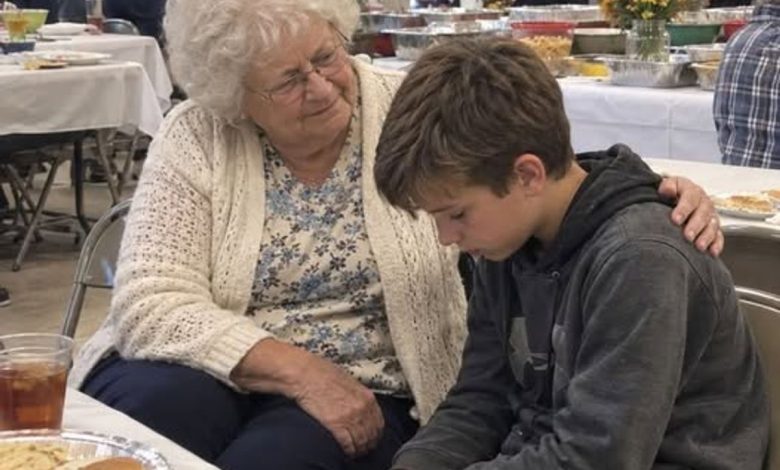
“I believe that boy right there knows something.”
Betty Shears was standing straight up at her table near the front of the fellowship hall. She’s seventy-nine years old. She’s buried two husbands. She’s played the organ at Mount Hope Community Church since before I was born.
And she was pointing her cane straight across the room at my grandson.
Every head at every table turned.
Wyatt’s ears went the exact color of the cranberry relish on the table in front of him.
I need to back up a little. Because you can’t understand what happened in that hall without understanding the two minutes before it.
It was the Wednesday supper before Thanksgiving. The fellowship hall was so full that night that Pastor Ward had to send the Hendricks boys to carry in extra folding chairs from the Sunday school rooms. Even then, my husband Dale and I ended up at the very end of a table jammed up against the dessert line. I could smell the cinnamon on somebody’s apple crisp the whole supper long.
Wyatt sat between us.
He’s twelve. My son Curtis’s boy. He’d been picking at the same plate of scalloped potatoes for ten minutes without eating one bite.
And I remember thinking, the way you sometimes think a small true thing right before a big one, that my grandson had been acting strange for two months. And I still didn’t know why.
Then Pastor Ward stood up at the front of the hall with his coffee cup in his hand. He said he had one announcement before the pie got cut.
Dana Dermot stood up beside him. Her husband Roy stood up too, and their boy Micah.
The whole hall went quiet. That particular kind of quiet when everybody already half knows what’s coming and wants to hear it said out loud anyway.
“Some of you know our family had a hard fall,” Dana said.
Her voice caught on the word hard.
“The furnace went in September, and we lost near everything upstairs. And so many of you fed us and gave us clothes and prayed for us. I’m never going to stop being grateful to this church.”
She stopped. She pressed her lips together. Roy put his hand flat on her back.
“But something happened a few weeks ago that I have to say in front of everybody. Because I don’t know how else to find out who did it.”
Beside me, Wyatt went very still.
Not fidgeting anymore. Still the way a rabbit goes still when a hawk’s shadow crosses the yard.
“Micah’s school lunch account had gotten so far behind I was sick about it,” Dana said. “I didn’t even know how far behind until the school called me. To tell me somebody had paid it off.”
The room was dead silent.
“All of it. A hundred and ten dollars. Paid in cash. And the woman in the office wouldn’t tell me who, because whoever did it asked her not to.”
She looked down at her son.
Micah was twelve. He was wearing a brand-new canvas work coat. It was still so new and stiff that you could see the fold creases in the sleeves from the store.
“And three days after that,” Dana said, “a box showed up on our porch. A coat. And boots. His size exactly. Nobody rang the bell. Nobody left a name.”
I felt my grandson’s shoulders come up around his ears. Like a turtle pulling into its shell.
And thirty seconds later, when Dana said the words I would have paid every dollar I own for her never to have needed to say, I understood. All at once. Completely.
I knew exactly where two hundred and forty dollars of lawn-mowing money had gone.
“Whoever you are,” Dana said, and her voice broke clean in half, “you kept my son from being the boy at school in the old coat. You kept him from being ashamed. I don’t care if you never tell me your name. I just need you to know what you did.”
Wyatt slid down in his folding chair so far and so fast that his chin nearly hit the edge of the table.
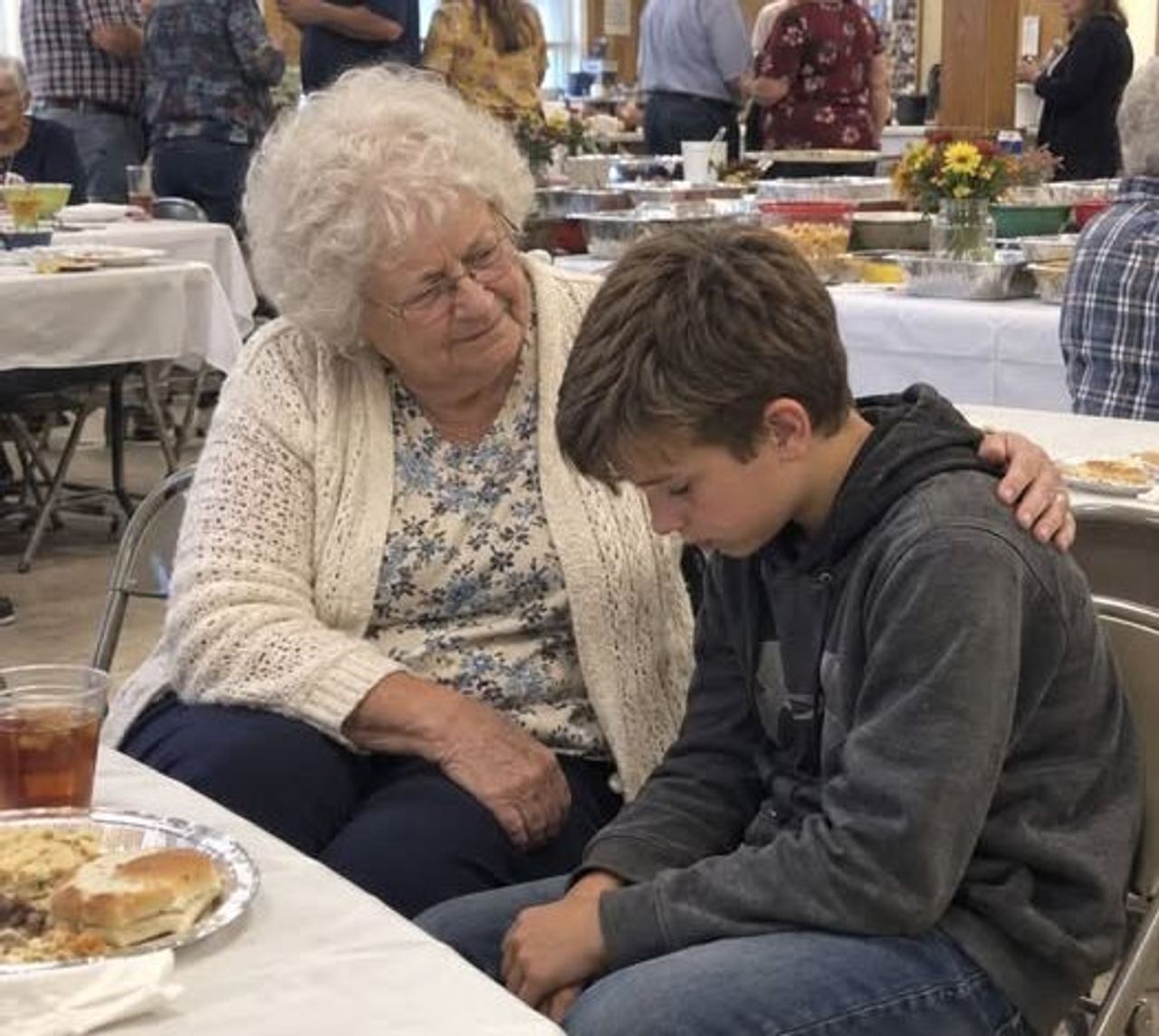
I put my hand on his shoulder.
And that was the moment half the room turned and looked at us. Because a grandmother can’t keep her face still when her heart is doing what mine was doing right then.
And that was when Betty Shears stood up with her cane.
But to understand how a twelve-year-old boy came to be sitting in that folding chair with two hundred and forty dollars of secret on his conscience, you have to go back to June.
To a boy with a push mower and a coffee can.
And a grandmother who thought she already knew everything there was to know about him.
My name is Lois Teague. I’m sixty-eight years old. I’ve lived in Henry County my whole life. Our town is small enough that the bank teller knows your middle name and the man at the feed store knows what your cattle eat.
Wyatt started mowing lawns the summer he turned eleven. The summer before this one.
Dale pulled an old Toro push mower out of our pole barn. It hadn’t run in six years. He went over it blade, belt, and spark plug until it ran like something twice its age had no right to run.
Dale is seventy. He was a lineman for the rural electric cooperative for thirty-one years before he retired. There isn’t a small engine in Henry County he can’t get running again.
He taught Wyatt to check the oil before every single job. And to never, ever mow wet grass.
“Wet grass clumps,” he said. “It chokes a mower. And a boy who ruins his equipment in July has no business in August.”
The two of them spent a whole Saturday out in the pole barn with that Toro flipped up on two cinder blocks. Dale talked Wyatt through cleaning the carburetor in the same slow, patient way he used to walk new linemen through a bucket truck inspection.
By the end of that afternoon, Wyatt could name every single part he’d touched.
That’s how Dale does things. He doesn’t hand a boy a mower that runs. He hands him a mower that doesn’t run yet, and the tools to make it run. Then he stands back with his arms crossed and lets the boy get frustrated before he says one word.
That’s how Dale taught our son Curtis. That’s how Dale’s own father taught him. I quit trying years ago to talk any of the Teague men out of doing things that slow, backward way. Because it works.
Word gets around fast in a town our size.
By this second June, Wyatt had eleven steady yards. Strung out along County Road 400, and two more streets into town once you cross the bridge by the grain elevator.
The Hoskins place, with its half acre of fescue.
The Petries, who always had a glass of sweet tea waiting for him on the porch rail, whether he wanted it or not.
And old Mrs. Feagin.
Mrs. Feagin is eighty-three. She’s lived alone since her husband passed four years ago. She paid Wyatt an extra five dollars every single week just to carry her trash cans back up from the road.
Both of us know she could do that herself if she had to.
Some jobs a boy does for the money. Some jobs you let a boy do for the company. And you pay him anyway, so neither one of you has to say that part out loud.
He ran that mower six days a week, rain permitting.
He came home every evening with grass stains on his knees and salt rings on his T-shirt from sweat. He’d drink two glasses of water standing at the kitchen sink without stopping to breathe.
And he kept every dollar he earned in a coffee can on the shelf in his closet.
A red Folgers can with the plastic lid pressed back on.
That’s where his father kept his money at that age, too. Curtis had a Folgers can on the exact same shelf, in the exact same bedroom, thirty years ago. Nobody told Wyatt that. Some things in a family just repeat themselves without anybody deciding they should.
I knew about the can.
I helped him count it in July. We sat on his bedroom floor and sorted the bills into piles. Ones, fives, tens, twenties. The way you’d sort canning jars by size.
It was a hundred and ninety dollars then.
“You’re going to be a rich man by Labor Day,” I told him.
He grinned at me. That big gap-toothed grin, with the space where his molar was still coming in.
“I’ve got plans for it, Grandma,” he said.
I didn’t ask what plans.
What business is it of a grandmother’s what a boy does with money he earned pushing a mower in ninety-degree heat?
Now, I know what somebody reading this is going to ask before I finish. So I’ll say it right now, plainly.
Why didn’t I just ask him?
I did ask him. Once.
The last Saturday in September, I went into his closet to put away some laundry. I noticed the coffee can was light. A lot lighter than it should have been, with three more weeks of mowing still left in the season.
I took it down. I looked inside.
There was maybe thirty dollars in it.
I found Wyatt in the kitchen and asked him straight out where the money had gone.
He looked at his shoes for a long time.
“It’s spent, Grandma,” he said. “And it’s spent right.”
That’s all he’d say. Not one word more.
Dale was out the window, fixing a fence post. He’d heard. He leaned his head in the back door.
“Lois,” he said. “Let the boy have his own business.”
And that was that.
We don’t interrogate kindness in this family. And I had a feeling, somewhere deep down, that it was kindness. If pressing him had meant making him explain somebody else’s shame out loud before he was ready, then I’d rather not know for one more month than make him do that.
It was the hardest thing I’ve ever not asked.
And I don’t regret it one bit.
The furnace at the Dermot place went bad on a Tuesday night in the middle of September.
A crack in the heat exchanger, the fire department said afterward. The kind that lets a slow smolder start up behind a wall where nobody can see it. Until it isn’t slow anymore.
Nobody was hurt. Thank the Lord, and thank the smoke detector Roy Dermot had put fresh batteries in not two weeks before.
But they lost the whole upstairs to smoke and heat. Every bedroom. Every closet. Every stitch of clothing.
The family had to move into Roy’s brother’s basement two towns over for six weeks while the insurance people did whatever it is insurance people do. Which in my experience is slowly.
The church took up what Pastor Ward calls a love offering the very next Sunday. People brought coats and canned goods and blankets and a folding cot. I put twenty dollars in the plate myself.
And I thought that was the end of what I personally had to do with it.
I heard about the fire the ordinary way news travels in a town our size. Standing in line at the diner on Main Street, listening to two women ahead of me talk about it over their coffee.
One of them said the fire department figured the smoke had built up behind the hallway wall for the better part of a week before anybody smelled it.
The other one said thank the Lord nobody was asleep upstairs when the detector finally went off.
I nodded along the way you do. I filed it away under things in town that are sad and none of my business. I went home and mentioned it to Dale at supper.
Neither one of us thought another thing about it.
Here’s what I didn’t know.
I didn’t know Wyatt sat two rows behind Micah Dermot in Mrs. Castellano’s sixth-grade homeroom.
I didn’t know that in late September, Micah started wearing the same thin gray hoodie to school every single day. Because it was the only coat that survived the fire.
I didn’t know the other boys had started calling him Gray Hoodie behind his back.
That’s what twelve-year-old boys do. They find the one true thing about another boy’s situation and turn it into a knife. Without ever once thinking of it as cruelty.
I didn’t know that the lunch register at the middle school flashes a little red number up on the screen when a kid’s account is behind. Right there at the counter, where every single kid in line can see it.
I found all of this out afterward. In pieces.
The way you put together a quilt from scraps people hand you one at a time.
Mrs. Pruitt in the school office told me some of it. Dana told me some of it. Ed Begley at the feed store told me some of it.
And Micah himself, eventually, sitting at my own kitchen table eating banana bread, told me the rest.
Here’s what I know now.
Sometime in early October, Wyatt asked if he could walk home from school a different way. Down Main Street. Past Begley’s Western and Farm Supply.
He went into Begley’s alone three separate afternoons before he ever did anything.
He just stood and looked at the coat rack. And the wall of boots. Like a man pricing a tractor he knows he can’t afford yet.
Ed Begley has run that store for thirty-eight years. He told me later he noticed a boy standing by the Carhartt coats for the better part of twenty minutes on a Thursday afternoon. Not touching anything. Just looking at the size tags.
When the boy finally came up to the counter, he asked a question Ed had never once been asked in thirty-eight years.
He asked whether Mr. Begley could find out a boy’s coat size and boot size. Without that boy ever knowing somebody had asked.
“I told him that was an unusual request for a customer his age,” Ed told me later.
We were standing in his store. He had his thumbs hooked in his belt, the way he stands when he’s telling you something he still can’t quite get over.
“And he looked me dead in the eye,” Ed said, “and he said, ‘It’s not for me, Mr. Begley. It’s for somebody who’d be embarrassed if he knew.’”
Ed shook his head slowly.
“I’ve sold coats in this town for thirty-eight years, Lois. I never once had a customer explain himself like that.”
Ed Begley is a careful man.
He called Mrs. Castellano at the middle school. She checked the size tags in the gym locker room. She didn’t tell a single soul why.
Three days later, Wyatt came back into Begley’s.
He had a hundred and thirty dollars folded up in a plastic sandwich bag inside his jacket pocket.
He bought a canvas work coat, brown, lined with flannel. And a pair of insulated work boots. Size eight.
He counted the money out on the counter twice. Every bill. The way his grandfather taught him to count anything that mattered.
Then he asked Mr. Begley for one more favor.
He asked him to deliver the box himself. On his own time. And leave it on a porch with no name attached.
Because a delivery truck from a feed store showing up at somebody’s house is a different thing in a small town than a stranger’s car pulling up after dark.
“You don’t want the credit,” Ed said to him. It wasn’t really a question.
“No sir,” Wyatt said. “If he knows it was me, he’ll feel like he owes me something. I don’t want him owing me anything. I just want him to have a coat.”
Ed Begley went home that night and told his wife the story twice. He said he couldn’t get over it. A sixth grader who understood debt and shame and pride better than most of the grown men who come through his register arguing over a ten percent discount.
He left the box on the Dermots’ porch at six-thirty the next morning, on his way to open the store.
The next part I found out from Mrs. Pruitt.
She’s worked in the middle school office for twenty-two years. She couldn’t keep it to herself after the supper. Nobody who was part of this story particularly wanted to keep it to themselves, once it was finally safe to tell.
On a Friday during his lunch period, Wyatt walked into her office.
He put a hundred and ten dollars on her desk. Counted twice.
He asked her to put it toward Micah Dermot’s lunch account. And to never, under any circumstances, tell anybody who it came from.
“I asked him if he was sure,” Mrs. Pruitt told me. “Because that is a great deal of money for a boy his age to hand over without blinking. I wanted him to understand there was no taking it back once it posted.”
“What did he say?”
“He said, ‘I’m sure. I earned it mowing. It’s mine to give.’”
She took off her glasses and wiped them on her sweater.
“Mrs. Teague, I’ve had grown men come into my office red-faced, arguing over a two-dollar late fee on a field trip form. I have never once had anybody, child or grown-up, be so certain about giving away that much money all at once.”
She told me she cried a little after he left. She’d told him that sometimes people did pay off accounts anonymously. Grown folks, mostly. Church people.
And Wyatt had said, “I know. That’s why nobody will think it’s me.”
“That might be the most practical sentence I’ve ever heard come out of a sixth grader,” Mrs. Pruitt said.
That was two hundred and forty dollars.
Every single cent he’d made all summer. Standing behind a push mower in heat that put salt rings on his shirts. Gone in eleven days.
And he never told a soul.
Not his best friend, Caleb. Not his grandfather. Not me.
Not even his own daddy.
Curtis drives a grain truck. He was two states over, hauling loads to Ohio, most of October. He didn’t hear one word about any of this until after the supper.
When I finally called him the next morning and told him, Curtis was quiet on the phone for so long I thought the call had dropped.
“Curtis? Are you there?”
Then he said, “That’s my boy.”
And his voice cracked clean through. The same way Dana Dermot’s had the night before.
I want that said plainly. Because a boy ought to have his father in his story, and not just his grandmother.
Curtis was away working the job that keeps this family’s lights on. Same as his own daddy was away doing linework thirty years before him.
And the very first thing Curtis did when he got home two days later was drive straight to the Dermots’ rental. With a chainsaw and a truck bed full of split oak.
Because Roy Dermot had mentioned offhand at the supper that his brother’s basement ran cold.
Curtis Teague doesn’t know how to show up empty-handed. Not once he knows where to show up.
But I’m getting ahead of myself.
The supper itself is the part you want. I was there. So let me tell it the way it really happened. Not the way it sounds all smoothed out afterward.
After Dana said what she said, the hall stayed quiet for what felt like a very long time. It was probably about four seconds.
Pastor Ward is a kind man. But not always a quick one.
He cleared his throat and said something about how generosity like that was exactly what this church ought to be known for. And then he started moving the evening along toward the pie. The way pastors do when they sense a thing has been said and doesn’t need more said on top of it.
That’s when Betty Shears stood up.
“I believe that boy right there knows something.”
And every head turned.
I’ll tell you what I did. Because I’m not proud of hesitating even one second. But I want this honest.
I loo…
Read more stories
- A Woman’s College Sweetheart Vanished 55 Years Ago in Vietnam – On Her Annual Flight to His Memorial, a Voice from the Cockpit Said Her Name
- On My Wedding Day, My Sister Spilled Instant Glue All Over My $18,000 Wedding Dress. She Simply Stood There Smiling While I Trembled With Embarrassment. She Thought She Had Ru!ned the Biggest Day of My Life — but Exactly One Hour Later, the Venue Door Opened, and That Confident Smile Vanished Instantly.
- My wife called while I was working and claimed my twelve-year-old daughter had taken $1,200 from her bedroom. By the time I arrived home, she had already gone through my daughter’s backpack, discovered $300, and placed her packed suitcase near the front entrance.
- After 27 Years My Husband Left for Another Woman and I Reclaimed My Life