Doctors Found Something Unusual During My Medical Exam but a 12 Year Old Record About My Husband Left My Son Speechless
The Letter in the Bedside Drawer
For twelve years, there was an envelope in my bedside drawer that I never opened.
It sat under a Bible, a tube of hand cream, my reading glasses, and a little stack of birthday cards from my grandchildren. A plain white envelope, sealed, with one word written across the front in my husband’s slanted handwriting.
Margaret.
Some nights, I took it out and held it. I turned it over. I ran my thumb along the flap.
Then I put it back.
Robert gave it to me three days before he died. He was in a bed at St. Francis Hospital in Hartford, with tubes in his arms and his skin the color of old paper. He pressed it into my hand and held my fingers closed around it.
“Promise me something, Maggie.”
“Anything.”
“Don’t open this unless something happens that you can’t explain.”
“What kind of something?”
He looked at me for a long time. His eyes were wet.
“You’ll know,” he said.
I promised.
And for twelve years, nothing happened that I couldn’t explain. My husband died. My children grew older. My grandchildren had children of their own. The maple tree in the backyard got taller, and my knees got worse, and the house got quieter.
Then, at eighty years old, my body started changing in a way I couldn’t explain.
And I finally understood what Robert meant.
My name is Margaret Whitmore. I’m eighty years old.
I’ve raised three children, welcomed seven grandchildren, and watched four great-grandchildren become part of our family. I was married to Robert Whitmore for fifty years. He sold life insurance for Charter Oak Mutual in Hartford for thirty-eight of them. He wore the same brown suit to work for a decade. He clipped coupons. He drove a Buick until it had two hundred and eleven thousand miles on it.
He was the most ordinary, dependable man I ever knew.
That’s what I believed, anyway.
After living through so much, I thought there was very little left that could surprise me.
I was wrong.
It started six months ago, in the spring.
At first, my waistline seemed a little bigger than usual. I noticed it when I was getting dressed for church. My navy skirt pulled a little at the button.
I assumed it was ordinary weight gain. I’d been eating too many of the lemon cookies my neighbor, Dottie, brings over on Thursdays. At my age, everything settles somewhere.
Then my favorite gray trousers stopped fitting.
By June, I couldn’t close the zipper on any pants I owned. I switched to loose cotton dresses, the kind with no waist at all. I told myself it was because of the summer heat.
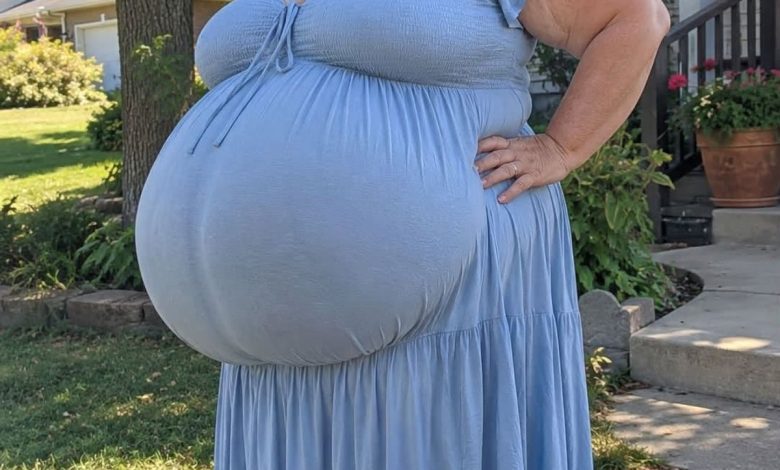
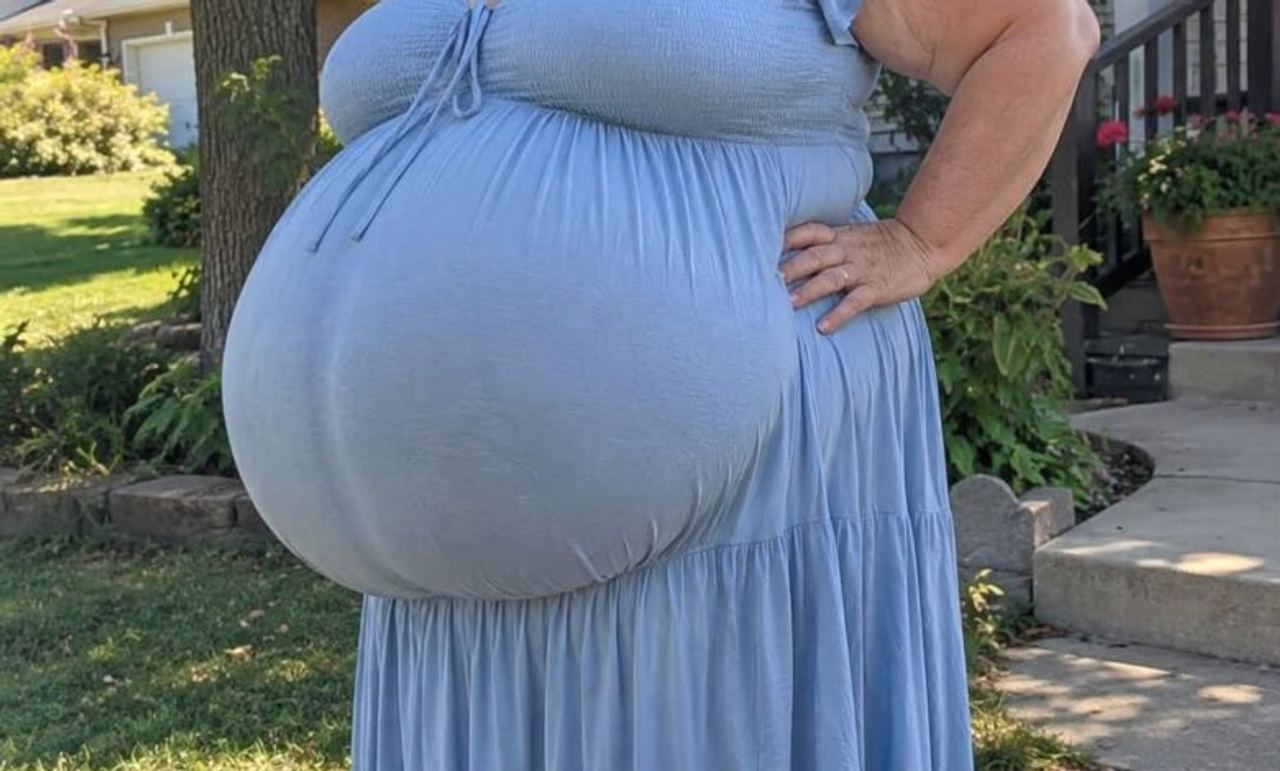
By August, my stomach was round and hard and swollen, like a woman five months along. Bending down to tie my shoes made me short of breath. Sitting in Robert’s old recliner felt like sitting with a bag of groceries in my lap.
I tried not to think about it.
When you’re eighty, you learn that if you go looking for problems in your body, you’ll always find some. So I stopped looking. I wore my loose dresses and ate less and told myself it would go away on its own.
On the first Sunday in September, the family came for dinner.
They do that once a month. It’s the only thing I’ve asked them for since Robert died.
My oldest son, Thomas, came with his wife, Sarah, and their two youngest grandchildren. Thomas is sixty-one. He’s an accountant, like I always knew he’d be. Even as a little boy, he lined up his crayons by color and counted them before bed.
My daughter, Claire, called on video from Phoenix, where she’s lived for twenty years. The grandchildren held the iPad up to the pot roast so she could see it.
Daniel couldn’t make it. He’s my youngest. Fifty-six. He’s a high school history teacher in Glastonbury, and he was chaperoning some kind of field trip.
I’d made pot roast and mashed potatoes and green beans with almonds. The same meal I’d made for Sunday dinner since 1970.
Halfway through dinner, Thomas set down his fork.
“Mom, I want to talk to you about the house again.”
I sighed. “Thomas, not tonight.”
“It’s always not tonight. We need to talk about it sometime.” He wiped his mouth with his napkin. “You’re eighty. The stairs are steep. The furnace is thirty years old. The property taxes went up again. Eight thousand four hundred this year.”
“I know what the property taxes are. I pay them.”
“You pay them out of Dad’s pension and your Social Security, and there’s barely anything left over at the end of the month. I’ve seen the statements.”
He has, too. Thomas has had power of attorney over my finances since I had pneumonia three years ago. I signed it in a lawyer’s office in West Hartford when I was too tired to argue. It was supposed to be just for emergencies. Thomas doesn’t really believe in the word just.
“I talked to a place in Avon,” he went on. “Brookside Senior Living. It’s beautiful, Mom. They have a library and a garden. Independent living to start, and assisted living if you need it later. The house would sell for at least four-ten. Probably more. That would cover Brookside for years.”
“I’m not moving to Avon.”
“Mom—”
“Your father and I raised you in this house. He planted that maple tree. I’m going to die in this house, Thomas, and you can sell it afterward and buy yourself a boat.”
The grandchildren went very quiet.
Thomas’s face got red. He picked his fork back up and stabbed a green bean.
That was when Sarah spoke.
Sarah is Thomas’s wife. She’s a dental hygienist, soft-spoken, and she married into this family thirty-four years ago and has never once called me anything but Mom. She’s the kind of person who notices when you’ve lost weight, or when you’re limping, or when you’ve been crying.
She was looking at my stomach.
“Mom, can I ask you something?”
“Of course, sweetheart.”
She hesitated. Then she said gently, “Have you spoken to your doctor about the swelling?”
Everyone looked at me.
I laughed lightly and patted my dress. “Sarah, I’m eighty years old. My body doesn’t work quite like it used to.”
But she didn’t smile.
“Margaret,” she said. She never uses my first name. “I really think you should have it checked. Please.”
Thomas looked at my stomach too, then. Really looked, for the first time all night.
“Mom,” he said slowly. “How long has it been like that?”
“A little while.”
“How long is a little while?”
“Since spring, I suppose.”
He stared at me.
“Since spring? Mom, that’s six months!”
“Don’t shout at me in my own dining room.”
“I’m not shouting. I’m—” He put his hands flat on the table. “You need to see a doctor. This week.”
“I’ll call Dr. Abrams’s office tomorrow,” I said.
“Dr. Abrams retired three years ago, Mom.”
I’d forgotten that.
Sarah reached across the table and squeezed my hand.
“I’ll make the appointment for you,” she said. “If you want.”
I promised I would do it myself.
I didn’t.
Three nights later, I woke up at two in the morning.
There was a strange pressure in my belly. A heaviness, low down, like someone was pressing on it from the inside. I lay on my back in the dark and tried to breathe slowly.
Then I felt something move.
A fluttering. A shifting. Like water sloshing in a jar. Followed by a deep, tight fullness that made it impossible to lie still.
I put my hand on my stomach.
Something shifted again under my palm.
I’ve had three babies. I know what it feels like when something moves inside you. This was nothing like that. And at eighty, with my husband twelve years in the ground, I knew perfectly well it couldn’t be.
For the first time, I was really frightened.
I lay there until the sun came up. I didn’t sleep. I just kept my hand on my stomach and listened to the clock in the hallway, the one Robert wound every Sunday for forty years, and that I still wind every Sunday now.
At seven o’clock, I called Daniel.
“Mom? Is everything okay?”
Daniel’s voice is the one in my family that sounds most like Robert’s. Low and calm, with a little gravel in it.
“Daniel, could you take me to the hospital? I think it’s time I found out what’s happening.”
He didn’t ask any questions. “I’ll be there in twenty minutes.”
He was there in fifteen.
He came in through the kitchen door with his car keys still in his hand and stopped dead when he saw me sitting at the kitchen table in my bathrobe.
“Mom,” he said. “Oh, Mom.”
I tried to smile. “I know. I look like I swallowed a beach ball.”
“Why didn’t you tell me it had gotten this bad?”
“I didn’t want to worry anyone.”
He crouched down beside my chair and put his hand on my shoulder. He squeezed it gently.
“That’s what we’re here for,” he said. “You know that.”
“Your father always said that.”
“I know,” Daniel said, and something passed over his face that I didn’t understand. Something heavy. Then it was gone. “Come on. Let’s get you dressed.”
At St. Francis, they took me back quickly. I think it was the size of my stomach. The nurse at the front desk took one look and said, “Let’s get you a wheelchair, dear.”
The doctor was a woman named Dr. Helen Parker. She was maybe fifty, with short gray hair, sneakers, and very steady hands. She asked me questions about my symptoms, my appetite, my bathroom habits, the fluttering. She pressed on my belly in several places. She frowned a little at what she felt.
“Mrs. Whitmore, I’d like to do an ultrasound right away.”
“All right.”
A technician named Rosa wheeled in a machine and turned off the overhead light. She spread cold jelly across my stomach and moved the wand slowly from side to side, studying the gray shapes on the screen.
She was quiet for a long time.
She adjusted the machine. She pressed harder. She tilted her head and looked at the images from several angles. She clicked some buttons and saved some pictures.
Then she said, “Excuse me for one moment,” and stepped outside.
I looked at Daniel. He was sitting in the plastic chair beside the bed, holding my hand.
“Do you think something’s wrong?”
He squeezed my hand. “Let’s hear what the doctor says.”
Dr. Parker came back about twenty minutes later. She brought another doctor with her. A tall man with glasses and a white coat that said Dr. Samuel Osei, Gynecologic Oncology.
That word. Oncology. I saw it before I saw his face.
Dr. Parker pulled up a stool beside the bed.
“Mrs. Whitmore,” she began, “the ultrasound has shown a very large fluid-filled mass in your abdomen. It appears to be coming from your left ovary.”
I swallowed.
“What does that mean?”
“It means we need more imaging to know exactly what it is, and how best to treat it. A CT scan this afternoon, and some blood tests.”
“Is it cancer?”
Dr. Osei spoke for the first time. He had a soft voice with an accent I couldn’t place.
“We don’t know yet,” he said. “Some of these are benign. Some are not. It’s very large. I’d estimate it’s close to thirty centimeters across. That’s why you’ve been feeling so much pressure. The fluttering you described was very likely the fluid shifting when you moved.”
Thirty centimeters. I didn’t know how big that was. Later, Daniel showed me with his hands. About the size of a large watermelon.
I looked down at my swollen belly.
“So that’s what’s been growing in there,” I said. “All this time.”
“It’s possible it’s been growing for many years,” Dr. Osei said. “Some of these grow very slowly. And then, at some point, quite quickly.”
“We need to finish the tests before we draw any conclusions,” Dr. Parker said gently. “I know that’s hard to hear.”
I nodded.
Daniel didn’t let go of my hand.
They did the CT scan that afternoon. Then the blood work. Then I lay in a small room on the fourth floor with a view of the parking garage and waited.
Thomas came. Sarah came. Thomas paced. Sarah held my other hand. Thomas made three phone calls in the hallway, one of them to our insurance company, Medicare supplemental. I heard him say “deductible” twice.
At five o’clock, Dr. Parker asked Daniel and me to come to her office. Just the two of us. Thomas had gone to get coffee.
Her office was small and cluttered, with framed photos of two teenage boys in lacrosse uniforms.
She sat down across from us with a thick folder.
“Mrs. Whitmore, the CT scan confirms what we saw on ultrasound. It’s a very large cystic mass on your left ovary. Dr. Osei believes it should be removed surgically, and fairly soon. He’ll go over all of that with you tomorrow.”
“All right.”
“But there’s something else I need to ask you about.”
She opened the folder.
“When we pulled your medical history, our system found an archived record from twelve years ago. It’s connected to an outside organization. I’ve never seen it before, and frankly, I’m a little puzzled by it.”
She turned the folder toward me.
“Have you ever received medical consultations or testing through a private research facility?”
I frowned. “Not that I remember.”
“The record is from a group called Carter Biomedical Research. In Cambridge, Massachusetts.”
The name went into me like a needle.
“Carter?” I repeated.
“Yes. Does that sound familiar?”
I didn’t answer right away.
Because for twelve years, I’d kept a memory to myself.
Three days before Robert died, I was sitting in the hallway outside his room at St. Francis. The same hospital. Two floors up.
A woman came down the hallway carrying a small silver briefcase. She was about sixty, with short dark hair and a navy blazer. She stopped at Robert’s door and knocked.
“Mrs. Whitmore?” she said to me. “I’m Evelyn Carter. I’m a—colleague of Robert’s. May I speak to him for a few minutes? Privately?”
A colleague. I’d never heard Robert mention her once in fifty years.
I said yes. I don’t know why. I suppose I was too tired to say anything else.
She was in there for almost twenty minutes. The door was closed. I sat in the hallway in a plastic chair and listened to the murmur of their voices through the wood. I couldn’t make out any words. Just that once, I heard Robert’s voice go up, sharp. And once, I thought I heard her crying.
When she came out, her eyes were red. She nodded to me without speaking and walked away down the hall with her silver briefcase.
I went back in.
Robert was lying very still, looking at the ceiling. He looked more troubled than I’d seen him in his whole illness. More troubled than when the doctors told him the cancer had spread to his liver.
He reached for my hand.
“Margaret,” he said, “if you ever have questions about my work, remember Evelyn Carter’s name.”
“Your work? Robert, you sell insurance.”
He closed his eyes.
“Just remember her name,” he said.
That night, he gave me the envelope.
He died three days later.
At the time, I thought he was worried about unfinished business. Insurance policies. Clients he hadn’t gotten to. Robert hated leaving anything undone.
I never told anyone about Evelyn Carter. Not my children. Not my sister-in-law. Not the priest.
Because a small, ugly part of me had always wondered.
A woman my husband never mentioned. A closed door. Tears. A silver briefcase.
And a man who had suddenly, in the last ten years of our marriage, started going to “insurance conferences” in Boston three or four times a year.
Now, sitting in Dr. Parker’s office, I said it out loud for the first time in twelve years.
“There was a woman named Evelyn Carter,” I said. “She visited my husband in the hospital. Right before he died.”
Daniel’s head snapped around.
“Mom,” he said. “Did you just say Evelyn Carter?”
“Yes. Why?”
He stared at the folder on the desk. His face had gone completely white. I’d never seen a grown man’s face lose its color so fast. It was like watching someone pull a plug.
Then he looked at me.
“Because Dad worked with her.”
I shook my head. “Your father sold insurance, Daniel. What would he possibly be doing with a medical researcher?”
My son hesitated. He looked at Dr. Parker. Then at the door. Then down at his hands.
“Mom, there’s something I never told you.”
My heart started beating faster. “What is it?”
He took a slow breath.
“After Dad died, when I was helping clean out the basement, I found a safe. Behind the old furnace. Behind the paneling. You didn’t know it was there.”
“A safe.”
“Gray steel. About this big.” He held his hands apart. “The combination was your anniversary. June 13th. 6-13-64.”
I couldn’t speak.
“It had business contracts in it,” Daniel said. “Research papers. Bank documents. Some old medical files. Letters.”
“And?” My voice came out thin.
Daniel looked at me with an expression I’d never seen on his face before. Not since he was a little boy and broke the window over the kitchen sink and couldn’t figure out how to tell me.
“One of those folders had your name written across the front,” he said.
“What did it say?”
He swallowed.
“Project Margaret.”
The room went completely silent.
Dr. Parker looked from Daniel to me and back again. She closed the folder very slowly.
“I think,” she said quietly, “I’ll give you two a few minutes.”
She stepped out and closed the door behind her.
I sat there for a long time.
“Daniel,” I finally said. “Why didn’t you tell me?”
He didn’t answer.
“Twelve years. You found a safe in my basement with my name on a folder, and you never said a word?”
“I couldn’t,” he said.
“Why not?”
He looked up at me. His eyes were wet.
“Because I thought Dad was having an affair,” he said. “With her. With Evelyn Carter.”
The words hit me harder than anything Dr. Osei had said all day.
Because I had thought it too.
For twelve years.
I just never let myself say it.
Then I remembered the envelope.
The one in my bedside drawer, under the Bible and the hand cream.
Don’t open this unless something happens that you can’t explain.
I turned to Daniel.
“Sweetheart, I need you to go home and bring me something.”
“What is it, Mom?”
“A letter your father left behind.”
Daniel looked confused. “What letter?”
I took a deep breath.
“The one he made me promise not to open unless something happened that I couldn’t explain.”
My son stared at me.
“And bring the safe,” I said. “Everything in it. Whatever’s still there.”
“It’s all still there,” Daniel said quietly. “I never took anything out. I locked it back up and put the paneling back. I couldn’t throw it away. And I couldn’t look at it again.”
He stood up.
At the door, he stopped and turned around.
“Mom. I’m sorry. I should have told you a long time ago.”
“Go,” I said. “Before I lose my nerve.”
Daniel came back at nine o’clock that night.
Thomas and Sarah had gone home. The nurse had given me something for the pressure, and the room was quiet except for the beeping of the IV pump.
Daniel came in carrying a cardboard file box. The old kind, from the office supply store, with handles cut into the sides. Dust on the lid.
And in his other hand, the envelope.
He set the box on the chair and handed me the envelope.
I held it in my lap. Twelve years. The paper had gone a little yellow at the corners.
“Do you want me to leave?” Daniel asked.
“No,” I said. “Stay.”
But I didn’t open it yet. I couldn’t. My hands wouldn’t do it.
“Show me what’s in the box first,” I said. “Show me what you saw.”
Daniel sat down on the edge of the bed and opened the lid.
The first thing he took out was a stack of receipts held together with a rubber band.
Hotel receipts. The Lenox Hotel, Boston. The Charles Hotel, Cambridge. Dates going back to 1999. Two nights. Three nights. Once, five nights.
I remembered those trips. The insurance conferences. Robert would pack his brown suit and his good shoes and come home tired and quiet.
“There are forty-one of them,” Daniel said. “I counted. That night. Twelve years ago. I sat on the basement floor and counted.”
Then he took out a checkbook register. Not our checkbook. A different one. A bank I’d never heard of. Eastern Commonwealth Savings.
The register was filled with Robert’s handwriting. Entries going back fourteen years. Checks, every few months.
Pay to: Carter Biomedical Research — $5,000.
Pay to: Carter Biomedical Research — $8,500.
Pay to: Carter Biomedical Research — $12,000.
“He had his own bank account,” I said slowly.
“He had his own bank account,” Daniel said.
And then Daniel took out a bundle of letters. Tied with a piece of white string.
They were addressed to Robert, at a P.O. Box in West Hartford. Box 1147. A box I’d never known existed.
The return address on every one was the same.
E. Carter.
Daniel untied the string and held out the one on top. It was opened. He’d read it twelve years ago, I could tell. The creases were soft.
I unfolded it.
Dear Robert,
I got your note. I understand why you can’t tell her yet. I know how much you love her. You don’t have to explain that to me. I see it every time you sit in my office.
But please don’t wait too long. Margaret deserves to know what you’ve done.
Yours, always grateful,
Evelyn
I put the letter down on the blanket.
“I understand why you can’t tell her yet,” Daniel said quietly. “Margaret deserves to know what you’ve done. Mom, I was forty-four years old. I’d just buried my father. And I found forty-one hotel receipts and a secret bank account and a woman writing to him at a secret mailbox that she was ‘always grateful.’”
He pressed the heels of his hands into his eyes.
“I hated him,” he said. “For a long time. I stood at his grave every Father’s Day with Thomas and Claire and I hated him and couldn’t tell anybody why. I decided I would never, ever let you find out. I thought it would kill you.”
I looked at my son. My youngest. Fifty-six years old, with gray in his beard, crying in a plastic hospital chair.
He’d been carrying this for twelve years. Alone. To protect me.
The same way, I was starting to realize, someone else in my family had carried something alone, to protect me.
“Daniel,” I said. “Did you read the folder? The one with my name on it?”
He shook his head.
“I saw the name. Project Margaret. And I closed the safe. I couldn’t do it. I couldn’t read about my mother in somebody else’s handwriting.”
He reached into the box and took out a thick brown accordion folder, held shut with an elastic band.
Across the front, in black marker, in handwriting that was not Robert’s:
PROJECT MARGARET — CONFIDENTIAL
I took a breath.
“First the letter,” I said. “Your father’s letter. Then the folder.”
I picked up the envelope.
I slid my thumb under the flap.
After twelve years, it opened easily. The glue had given up long ago.
There were two pages inside. Robert’s handwriting. Shaky by then, from the medicine and the weakness. But still his.
I read it out loud, so Daniel could hear.
My dear Maggie,
If you’re reading this, then something has happened, and I’m not there to help you. I’m so sorry. That’s the thing I’m sorriest about.
I need to tell you something I should have told you twenty years ago. I didn’t, because I was a coward, and because I couldn’t stand to see you frightened. That was wrong of me. You were always braver than I was.
You remember your sister Ruth. And your mother before her. You never talked about it much. But I remember holding you on the kitchen floor the night Ruth died. You said, “It’s going to come for me too, Robert. It took Mama, it took Ruthie, and it’s going to come for me.” I said it wouldn’t. I didn’t know that. I just said it.
I couldn’t stop thinking about it. For years. I sell life insurance, Maggie. I spend all day looking at tables of numbers that tell you who is going to die and when. And the numbers for women like you, with a mother and a sister lost to ovarian cancer, scared me to death.
So I did something about it. Without asking you.
There is a woman named Evelyn Carter. She’s a doctor. A research scientist. She runs a small lab in Cambridge that studies early detection of ovarian cancer, the kind that took Ruth. It’s called the silent killer because by the time women feel it, it’s usually too late. Evelyn is trying to change that.
I’ve been helping her. With money. For a long time.
I know what that money could have been. Ireland. A new kitchen. The cruise you wanted to take for our fortieth. I told you my commissions were smaller than they were. I kept my own account. I lied to you about the conferences in Boston. I went to Evelyn’s lab. I sat in on her meetings. I helped her with her grant applications, because it turns out a life insurance man is very good at explaining risk to people with money.
I never, ever betrayed you with her, Maggie. Not once. Not in thought. I need you to believe that. If Daniel or anyone finds the papers and thinks otherwise, please tell them this, in my words: there has only ever been you.
Evelyn has everything. The rest of the story is hers to tell. She knows things about your health that I was going to tell you myself, and now I’ve run out of time. Please find her.
And go to th…
Read more stories
- Ella Langley is back on top of the Billboard Hot 100 with “Choosin’ Texas.”
Taylor Swift’
- Can You Name These 10 Hollywood Legends? Most People Score 6/10
- A Woman Caught Her Husband With Her Best Friend On A Plane And Made Them Both Regret It.!!!
- My 78 Year Old Boss Fired Me After Years of Loyalty Then Offered Me One Condition That Changed Everything