Seven-Year-Old Girl Calls 911 After Her Father Disappears for Four Days, and the Truth Touches an Entire Neighborhood
Everything for Love
Part One: Thirty Minutes
Four days before the phone call, Raymond Cole stood at his kitchen counter counting money.
It was a little after eight on a Thursday night in late October. Rain had been falling since noon, hard and steady, drumming on the metal awning over the back steps. The kitchen light flickered every few minutes, the way it had since the landlord stopped answering Raymond’s calls about the wiring.
On the counter in front of him were three crumpled ten-dollar bills, a five, four ones, and a handful of change. He counted it twice. Forty-one dollars and sixty cents.
Behind him, in the small living room, his daughter coughed.
Ashley was seven. She was curled on the couch under a fleece blanket printed with cartoon dogs, holding a stuffed puppy with one floppy ear. The puppy’s name was Buddy, and he had been her best friend since she was two. His fur was worn thin in places from years of being held.
“Daddy?” she said. “My tummy hurts again.”
“I know, sweetheart,” Raymond said. “I’m going to fix it.”
Ashley had a kidney condition called nephrotic syndrome. The doctors had diagnosed her eight months earlier, after her face and stomach started swelling for no reason anyone could see. It meant her kidneys leaked protein they were supposed to keep, and her body held on to water it was supposed to let go.
It could be managed, the doctors said. With medicine, regular checkups, and careful attention to salt and fluids. Most children did well.
But the medicine cost money, and the checkups cost money, and three weeks earlier the clinic had told Raymond that Ashley’s coverage had lapsed because of a paperwork problem he still didn’t understand.
Raymond was thirty-four. He worked nights loading trucks at a distribution warehouse twenty minutes away. Until September, he’d had a car to get there. Then the transmission failed, and he sold what was left of the car for scrap to pay October’s rent.
Now he caught a ride with a coworker when he could and walked when he couldn’t. He’d missed two shifts in October because Ashley had been too sick to leave. The warehouse had warned him that one more would cost him the job.
He hadn’t eaten dinner that night. He’d given Ashley the last of the chicken and rice and told her he’d had a big lunch.
Ashley’s mother, Diana, had died two years earlier.
It happened fast. A headache on a Tuesday, an ambulance on Wednesday, a hospital chaplain on Thursday. A blood vessel in her brain, the doctors said. Nothing anyone could have seen coming.
Raymond and Ashley moved out of the apartment where Diana had painted sunflowers on the bathroom wall. They moved to a small rented house on Linden Street, on the outskirts of town, where the rent was cheaper and nobody knew them.
The neighbors weren’t unfriendly. They just didn’t know him. Raymond worked nights and slept days, and in a neighborhood where people noticed every car, a man with no car and no wife and a sick little girl was a mystery nobody had bothered to solve.
Raymond looked down at the money on the counter. Forty-one dollars and sixty cents wasn’t enough for Ashley’s prescription, groceries, and the electrolyte drinks her doctor wanted her to have when she felt sick.
He looked at his left hand.
His wedding ring was still there. A plain gold band. He’d never taken it off, not once in two years.
He slid it off his finger and put it in his pocket.
There was a pawn shop on Route 9, about a mile away, that stayed open until ten. Next to it was an all-night pharmacy and a small grocery store. If he walked fast, he could get there, get the money, buy everything, and be home in thirty minutes.
Maybe forty, in the rain.
He wrote a shopping list on the back of an envelope so he wouldn’t forget anything.
Rice. Chicken. Electrolyte drinks. Ashley’s medicine.
He left it on the kitchen table. He’d remember. He always remembered.
He went to the couch and knelt down beside his daughter.
“I have to run to the store,” he said. “For your medicine. And some good food. I’ll be back in thirty minutes.”
Ashley looked at the rain against the window. “It’s really wet out there.”
“I’ve got my jacket,” Raymond said. “And I’m fast.”
She hugged Buddy tighter. “Can I come?”
“Not in this rain, sweetheart. You stay warm. Lock the door behind me. Don’t open it for anyone. I’ll knock three times, and you’ll know it’s me.”
He hugged her.
He held her longer than usual. Long enough that she noticed. Her small arms wrapped around his neck, and he could feel how thin she’d gotten, and how warm.
“Daddy,” she said. “Why are you squeezing so hard?”
Raymond closed his eyes.
“Whatever happens, Ashley,” he said quietly, “always remember that it’s love. Everything I do is for love. Okay?”
“Okay,” she said.
“Say it back to me.”
“Everything is for love,” Ashley said.
He kissed the top of her head. Then he zipped up his jacket, pulled his hood over his head, and stepped out into the rain.
She heard the lock click behind him. She watched through the front window as he walked down the cracked path to the street and turned left toward Route 9.
Then he was gone.
Part Two: The Call
The night shift at the county emergency dispatch center was usually quiet on Mondays. Victor Alvarez had been working it for eleven years. He knew which nights brought car accidents, which brought domestic calls, and which brought nothing but drunk teenagers and lost dogs.
At 11:47 p.m., his headset lit up.
He heard rain first. Heavy rain, pounding on something metal. Then breathing. Small, shallow breathing.
“911, what’s your emergency?”
For a moment, nobody answered. Victor waited. He’d learned that the quiet calls were often the ones that mattered most.
Then a voice came through, so soft he had to press the headset against his ear.
“Daddy told me he’d only be gone for thirty minutes,” a little girl said. “But before he left, he hugged me and said, ‘Whatever happens, Ashley, always remember that it’s love. Everything is done for love.’”
She took a shaky breath.
“But it’s been four days now,” she whispered. “Daddy says it’s love. But I’m scared.”
Victor sat up straight. His pen was already moving.
“Can you tell me your name, sweetheart?” he asked.
“Ashley. I’m seven years old.”
The address came up on his screen. A small house on Linden Street, in a modest neighborhood on the edge of town. Small houses, chain-link fences, neighbors who knew each other’s cars.
“Ashley,” Victor said. “Are you there all by yourself?”
There was a long silence. The rain kept pounding.
Then Victor heard a faint, broken sob.
“Yes,” she said. “Daddy went out to get my medicine and something to eat. Before he left, he hugged me really tight and said everything he did was because he loved me. But he never came home.”
Her voice shook.
“My stomach hurts so much,” she said.
Victor kept his voice calm and gentle, the way he’d been trained. Inside, his heart was pounding.
“When was the last time you ate anything, sweetheart?”
“I don’t know,” Ashley said. “There was some soup. But it smelled strange. I ate a little and then I threw up. I drank water from the kitchen sink. I gave Buddy some water too.”
“Who’s Buddy?”
“My stuffed puppy.”
Victor typed a priority alert to the nearest patrol unit while he kept talking.
Child alone four days. Age 7. Ill. Possible dehydration. Father missing.
“Ashley,” he said. “There’s a police officer named Laura who’s on her way to help you right now. I want you to stay on the phone with me until she gets there. Can you do that?”
“Okay.”
“You’re doing the right thing by calling,” Victor said. “You’ve been very brave.”
“Am I in trouble?” Ashley asked.
“No, honey. You’re not in trouble at all.”
“Daddy said not to open the door for anybody,” she said. “He said he’d knock three times.”
Victor swallowed.
“That was good advice from your daddy,” he said. “When Officer Laura gets there, she’s going to tell you her name through the door. And I’ll still be right here on the phone. Then you can decide if you want to open it. Okay?”
“Okay,” Ashley whispered.
Part Three: Laura
Officer Laura Benson had been on patrol for nine years. She’d answered calls she still thought about at three in the morning. She had a nine-year-old son named Caleb who was asleep at her mother’s house while she worked nights.
When the dispatch came through, she was already turning onto Route 9.
Child alone four days. She read it twice. Then she hit the lights and pressed the accelerator.
The house on Linden Street was nearly pitch-black.
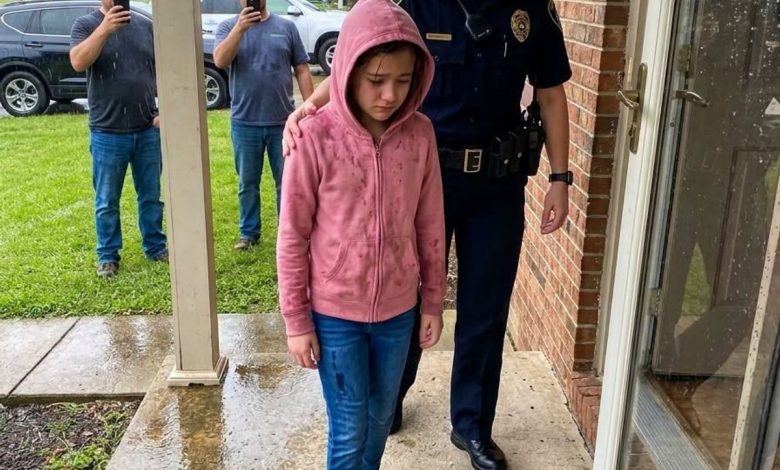
Rainwater poured off the edge of the porch roof in a sheet. The mailbox leaned toward the street on a rotting post. The front yard was mostly mud. A single curtain moved slightly behind the front window as her headlights swept across it.
Laura parked, grabbed a flashlight, and walked up the cracked path. She knocked gently. Not the hard knock officers usually use. A soft one.
“Ashley?” she said. “My name is Laura. I’m here to help you, sweetheart.”
Inside, Laura heard small footsteps. Then nothing.
“Victor’s still on the phone with you, right?” Laura said through the door. “He told me you’ve been really brave.”
The door opened just a crack.
One frightened eye appeared in the gap. Brown. Red-rimmed.
“Are you going to be mad at me?” Ashley asked.
Laura immediately crouched down so her face was level with the child’s. She didn’t want Ashley staring up at a uniform and a badge.
“No, honey,” she said. “You haven’t done anything wrong. Nobody is going to yell at you.”
The eye studied her for a long time.
“Daddy said to wait for three knocks,” Ashley said.
“I know,” Laura said. “Your daddy was trying to keep you safe. And you did exactly what he said. But I think it’s time to let someone help you now.”
Slowly, the door opened wider.
Ashley stood barefoot on the cold floor. She was wearing an oversized gray T-shirt that hung down past her knees, the kind a grown man wears to work. It said Ridgeline Distribution on the front. She held a stuffed puppy by one floppy ear.
Her lips were dry and cracked. Her arms were thin, too thin, but her stomach looked swollen under the loose shirt. Her face was puffy around the eyes.
She swayed a little as she stood there.
A wave of anger rose up in Laura’s chest. She pushed it down. This little girl didn’t need another frightened grown-up. She needed someone who could think clearly.
“Can I come in?” Laura asked.
Ashley nodded.
The house was cold. The heat was off, or maybe it had never been on. Laura’s flashlight swept across a small living room with a couch, a blanket printed with cartoon dogs, and a stack of children’s books on the floor.
On the wall was a framed photograph. A woman with curly dark hair laughing in a sunflower field, holding a toddler on her hip.
The kitchen was small and clean, except for a pot on the stove. Laura opened the refrigerator. Inside were a cloudy plastic container of soup, a bottle of mustard, and nothing else.
On the kitchen table lay an envelope with a handwritten list on the back.
Rice. Chicken. Electrolyte drinks. Ashley’s medicine.
Laura picked it up. The handwriting was careful and neat. Next to the telephone on the counter was a sticky note in the same hand.
Urgent appointment — Dr. Patel, pediatric kidney clinic. Call first thing Monday.
Today was Monday.
Laura looked around the kitchen again. At the empty refrigerator. At the clean dishes stacked in the drying rack. At a calendar on the wall with doctor’s appointments written in every week and the word PAYDAY circled on Friday.
These weren’t the belongings of a man who’d planned to abandon his child and disappear. These were the belongings of a man who’d meant to come back.
By then, several neighbors had gathered outside the chain-link fence.
The police lights had drawn them out. A woman in a yellow raincoat stood with her arms folded. A man held an umbrella over his teenage son. Another woman was already holding up her phone, recording.
The woman in the yellow raincoat spoke loudly enough for everyone to hear.
“I always knew Raymond wasn’t capable of raising a little girl on his own,” she said.
The woman with the phone nodded. “That poor child,” she said into the camera. “Her father just left her here all alone.”
Someone else murmured, “I never saw him in the daytime. Always out at night.”
“Probably drinking,” the man with the umbrella said.
Laura heard every word. She looked down at the shopping list in her hand. At the note about the urgent appointment. Then back at Ashley, who was holding on to the kitchen doorway to stay upright.
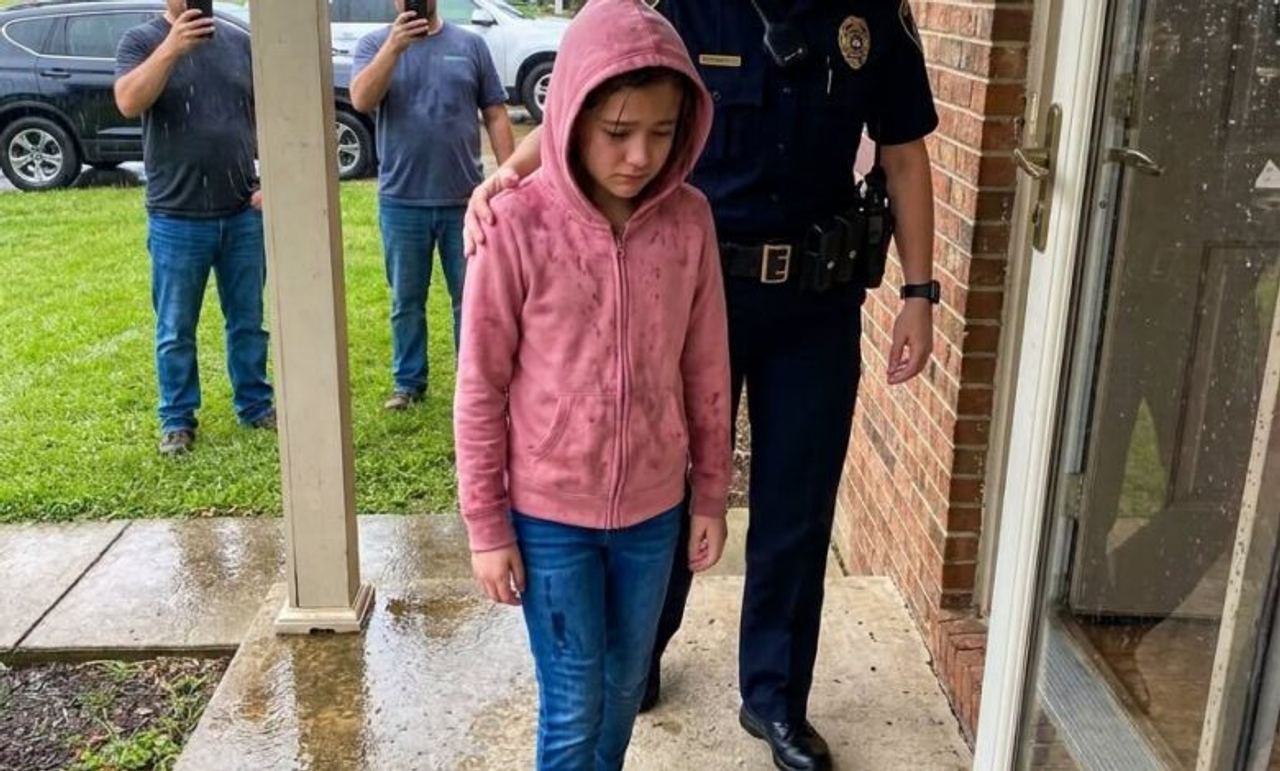
“Ashley,” Laura said gently. “I’m going to pick you up now. Is that all right?”
The little girl gave a faint nod.
Laura slipped one arm behind her back and the other beneath her knees. She was so light. Lighter than Caleb had been at four.
As Laura lifted her, Ashley’s body went limp.
The stuffed puppy slipped from her hand and fell onto the wet porch boards. Laura tightened her arms around the child and pressed the button on her radio.
“Child unconscious,” she said. “Possible severe dehydration. I need an ambulance here immediately.”
The neighbors went silent.
Laura pressed two fingers against Ashley’s neck. She felt a pulse. Faint, but there. She pulled the little girl close and wrapped her inside her own rain jacket to keep her warm.
Then she bent down, still holding Ashley, and picked up the stuffed puppy from the porch.
She turned toward the fence. Toward the woman in the yellow raincoat, and the woman with the phone, and the man with the umbrella.
“This doesn’t look like abandonment,” Laura said firmly. “This looks like a father who went to the store and didn’t make it home.”
She held up the soggy shopping list.
“Something has happened to him,” she said.
Part Four: St. Mary’s
The ambulance took Ashley to St. Mary’s Children’s Hospital, twenty minutes away.
Laura followed in her cruiser with Buddy on the passenger seat. At every red light, she looked over at the stuffed puppy and thought about the gray work shirt hanging past Ashley’s knees.
Ridgeline Distribution.
The emergency doctor was a calm woman named Dr. Renee Okafor. She met the ambulance at the doors and stayed with Ashley for two hours.
“Severe dehydration,” she told Laura in the hallway afterward. “Her electrolytes are badly out of balance. She’s also having a flare of her kidney condition, which is why she’s so swollen. Without her medicine, it got much worse. And the soup she ate was spoiled, which caused the vomiting.”
“Is she going to be okay?” Laura asked.
Dr. Okafor nodded slowly. “If she’d waited another day, I’d be less sure,” she said. “She called at the right time.”
Laura sat down in a plastic chair in the hallway. She realized her hands were shaking.
“Seven years old,” she said. “Four days alone. And she called because she was scared.”
“She told the nurse something,” Dr. Okafor said. “When they were starting her IV. She asked if her daddy was going to be in trouble. She said he told her everything he did was for love, and she didn’t want people to think he was bad.”
Laura closed her eyes.
A social worker from Child Protective Services arrived at two in the morning. Her name was Gloria Patterson, and she had a tired face and a kind voice.
“We’ll need to find a placement for her once she’s released,” Gloria said. “Temporary foster care, most likely. Unless there’s family.”
“There’s a father,” Laura said.
“Who left her alone for four days.”
“Who went to the store and didn’t come back,” Laura said. “There’s a difference.”
Gloria looked at her for a long moment.
“You think something happened to him,” she said.
“I think a man who writes his daughter’s medicine on a shopping list and circles her doctor’s appointment on the calendar doesn’t just walk away,” Laura said. “I think he’s somewhere. And I think he doesn’t know she’s here.”
“Then find him,” Gloria said quietly. “Before I have to make decisions I can’t take back.”
When her shift ended at seven in the morning, Laura didn’t go home.
She called her mother and asked her to take Caleb to school. Then she sat in her car in the hospital parking lot with a notepad and started making calls.
Part Five: The Search
Laura started with what she knew.
Raymond Cole. Thirty-four. Last seen Thursday night, around eight-fifteen, walking toward Route 9 in heavy rain. He’d told his daughter he was going for medicine and food.
There was only one pharmacy within walking distance of Linden Street that stayed open late. A Greenway Pharmacy on Route 9, next to a small grocery store and a pawn shop.
She drove there first.
The pharmacist on duty was a young man named Kevin. Laura showed him a photo of Raymond she’d found in Ashley’s house, a picture of him holding Ashley at a birthday party, both of them wearing paper crowns.
Kevin studied it.
“Yeah,” he said. “I remember him. Thursday night. It was pouring. He came in soaking wet.”
“What did he buy?”
Kevin pulled up the record.
“Prednisolone liquid for a pediatric patient,” he said. “Ashley Cole. And two bottles of electrolyte drink. Pedialyte. The grape kind.”
“How did he pay?”
“Cash,” Kevin said. “He counted it out on the counter. He was a few dollars short at first. He asked if he could put back one of the drinks. I told him not to worry about it. I covered the difference.”
He looked embarrassed.
“He looked like he hadn’t slept in a week,” Kevin said. “He kept saying thank you. He said his little girl was sick and he had to get home.”
“What time did he leave?” Laura asked.
Kevin checked the receipt. “Eight fifty-two,” he said. “He went next door to the grocery store, I think. I saw him through the window.”
The grocery store’s manager pulled the receipt for her. Rice. A package of chicken thighs. A box of saltine crackers. A small jar of applesauce. Total: twenty-three dollars and fourteen cents. Paid in cash at 9:07 p.m.
The pawn shop owner confirmed the rest.
“Wedding ring,” he said. He took a small envelope from a drawer and showed it to her. A plain gold band. “Fourteen karat. He sold it for sixty dollars. Thursday, about eight-thirty. He asked me not to melt it down for a while. Said he wanted to buy it back when he got paid.”
He turned the ring over in his fingers.
“Most guys sell rings because they’re angry,” he said. “This guy looked like he was saying goodbye to somebody.”
Laura stood in the parking lot in the gray morning light.
Raymond Cole had sold his wedding ring, bought his daughter’s medicine and groceries, and left the grocery store at 9:07 p.m. on Thursday. He’d had less than a mile to walk home.
Somewhere on that mile, he’d disappeared.
She drove the route slowly. Route 9 for half a mile, then a left onto Carver Road, then a right onto Linden. There were no sidewalks on Route 9. Just a narrow gravel shoulder and a drainage ditch.
Halfway along that stretch, she pulled over.
There were marks on the shoulder. Tire marks, half washed out by four days of rain. And in the tall grass at the edge of the ditch, something white.
Laura climbed down into the ditch.
It was a plastic grocery bag. Torn. Muddy. Inside was a box of saltine crackers, crushed. A jar of applesauce, unbroken. A package of rice that had split open and spilled into the mud.
And a small white pharmacy bag, still folded at the top.
She opened it with shaking hands. Inside was a bottle of liquid medicine with a printed label.
Prednisolone oral solution. Patient: ASHLEY COLE. Take as directed.
Part Six: John Doe
Laura called the accident desk at the county sheriff’s office from the side of the road.
“Thursday night,” she said. “Between nine and nine-thirty. Route 9 between the Greenway Pharmacy and Carver Road. Any pedestrian incidents?”
The clerk typed. Laura could hear rain on the roof of her cruiser and her own heartbeat in her ears.
“One,” the clerk said. “Pedestrian struck at 9:18 p.m. Driver stopped and called it in. Victim transported to Riverside General. Unconscious at the scene. No identification.”
“No identification?”
“Says here no wallet, no phone,” the clerk said. “Driver said he came out of nowhere in the rain. She never saw him until he was in front of her. She was pretty shaken up.”
“Is he alive?” Laura asked.
The clerk paused. “Last update was Friday morning,” she said. “Listed as critical. Unidentified male, approximately thirty to forty years old.”
Laura was already turning the car around.
Riverside General was a different hospital system from St. Mary’s. Across the county line. Different records, different computers. Nobody had connected a missing father with a little girl alone on Linden Street, because nobody had known the little girl existed.
The nurse at the ICU desk was a man named Terrence with a gray beard and tired eyes. Laura showed him her badge and the photo of Raymond in his paper crown.
Terrence looked at it for a long time.
“Bed seven,” he said quietly. “We’ve been calling him John Doe since Thursday.”
Raymond lay in a hospital bed with tubes and wires attached to him. His head was bandaged. His left leg was in a brace. A machine beside him beeped slowly and steadily.
He was much thinner than the man in the photograph.
“Head injury,” Terrence said. “Broken leg. Broken ribs. He had surgery Friday to relieve pressure on his brain. The doctors kept him sedated for two days to let the swelling go down. They started waking him up yesterday.”
“Has he said anything?”
“Not much,” Terrence said. “He’s been in and out. Confused. He keeps trying to pull out his IV. We had to put mitts on his hands.”
He paused.
“There’s one thing he keeps saying,” Terrence said. “Every time he comes close to waking up. We thought it was a name, but we couldn’t figure out whose.”
“What is it?”
“Three knocks,” Terrence said. “Over and over. Three knocks. I have to knock three times.”
Laura sat down in the chair beside the bed. She put her hand on Raymond’s arm, above the IV.
“Raymond,” she said quietly. “My name is Laura. I’m a police officer. I need you to know something.”
His eyelids flickered.
“Ashley’s safe,” Laura said. “She called 911. She was very brave. She’s at St. Mary’s. The doctors are taking care of her.”
Raymond’s fingers moved inside the padded mitt.
His eyes opened. Just a little. They found Laura’s face, unfocused at first, then sharper.
His lips moved. Laura leaned closer.
“Ash,” he whispered. “Medicine.”
“I found it,” Laura said. “In the ditch. With the groceries. The doctors have her on the right medicine now.”
Tears slid out of the corners of Raymond’s eyes and ran down into the bandage on his head.
“Four days,” he whispered. “Oh God. Four days.”
Part Seven: The Neighborhood
By Tuesday afternoon, the video had been shared more than forty thousand times.
It was the clip recorded by the neighbor on Linden Street. Rain. Police lights. A small barefoot girl being carried from a dark house. The woman’s voice in the background saying, Her father just left her here all alone.
The caption read: Father abandons sick 7-year-old for FOUR DAYS. Where is the justice??
The comments were brutal.
People called Raymond a monster. People wanted his name. People wanted him arrested. Somebody found the address and posted it. Somebody else said they hoped he never got his daughter back.
Laura read the comments in the hospital cafeteria on her phone. She read them until she couldn’t anymore.
Then she called Victor.
Victor had finished his shift Tuesday morning. He’d gone home and couldn’t sleep. When Laura called, he picked up on the first ring.
“Did you find him?” he asked.
She told him everything. The pawn shop. The pharmacy. The ditch. Bed seven at Riverside General.
Victor didn’t say anything for a long time.
“He was carrying her medicine,” he said finally. “When he got hit.”
“He was carrying her medicine,” Laura said.
“Have you seen the video?” Laura asked.
“I’ve seen it,” Victor said. His voice was tight. “I’ve seen what they’re saying.”
“I don’t know how to fix that,” Laura said. “I can tell my sergeant. The department can put out a statement. But people believe the first story they hear.”
Victor was quiet again.
“Then we need to tell them a better one,” he said.
That evening, the police department released a short statement. It explained that Raymond Cole had not abandoned his daughter. He’d been struck by a vehicle while walking home with her medicine and had been hospitalized without identification. Investigators found no evidence of neglect, only a family facing serious hardship.
T…
Read more stories
- Stars who have said no to the Super Bowl halftime show as JAŸ-Z confirmed as 2027 headliner
- An 81-Year-Old Veteran Walked Into the Army Base Alone—What Happened Next Left Everyone Speechless
- Emily Ann Roberts shared a heartfelt note to Thomas Rhett as his tour came to a close in O
- A 101-year-old man was brought to court for stealing more than $2,000 worth of items — He