I Walked Into My Son’s Classroom to Stop a Bully. I Thought I Saved Him. He Said I Made His Life Worse
This fictional story is written to raise awareness about bullying, disability, parental absence, and the long road to rebuilding trust. It avoids graphic detail and focuses on accountability, growth, and healing.
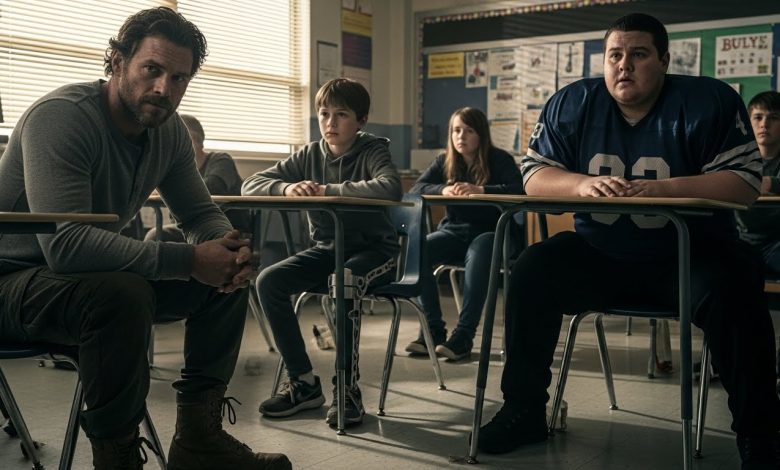
Chapter 1: The Silence Outside Room 3B
Elementary schools all smell the same. Floor wax, damp paper towels, and something nervous that never quite leaves the air.
I stood outside Room 3B, staring through the small glass window like a stranger at my own life. Civilian clothes still felt wrong on me. My hands shook, not from what I’d seen overseas, but from what I was about to see now.
Leo.
My son.
The boy I hadn’t protected when it mattered most.
Inside the classroom, kids laughed and moved freely. Phones were out. Paper flew. And in the back row, I saw him. Smaller than I remembered. Hunched. Drawing instead of talking.
Then I saw the foot.
Rhythmic. Deliberate. Tapping first against the metal brace, then against flesh.
Leo flinched but didn’t turn around.
The teacher didn’t look up.
Something in me snapped.
Chapter 2: Walking In Too Loud
I opened the door without knocking.
The sound echoed. Conversations died instantly.
I didn’t shout. I didn’t threaten. I simply walked forward and placed myself between my son and the boy behind him.
“That stops now,” I said quietly.
The bully froze. The confidence drained from his face.
I didn’t touch him. I didn’t need to. Authority isn’t always volume. Sometimes it’s certainty.
Only then did I look at Leo.
He didn’t look relieved.
He looked afraid.
Chapter 3: The Walk Out
I took Leo’s hand and walked him out of the room.
No applause. No dramatic ending.
Just a hallway full of eyes watching the kid who needed his father to step in.
Outside, Leo pulled his hand away.
“You didn’t save me,” he said flatly. “You made me a target.”
The words landed harder than anything I’d heard in years.
Chapter 4: A Different Kind of War
In the car, he explained what I couldn’t see.
The daily mockery. The videos. The waiting.
“If I ignore him, it ends in five minutes,” Leo said. “Now it won’t.”
He was right.
I had approached a school like a battlefield. But this wasn’t war. This was survival.
Chapter 5: Learning to Stay Quiet
The next morning, I didn’t go inside.
I watched from a distance as Leo was mocked again. Not hit. Not pushed. Just copied. Imitated. Filmed.
And I did nothing.
It nearly broke me.
But for the first time, I understood: showing up loud wasn’t helping.
Chapter 6: Building Instead of Fighting
I found a robotics club at the community center.
No therapy talk. No pity.
Just tools. Metal. Ideas.
I volunteered quietly. Wore a welding mask. Stayed anonymous.
Leo came.
He didn’t recognize me. And that was the point.
I didn’t save him. I coached him.
I didn’t protect him. I empowered him.
Chapter 7: The Anchor
Leo built a robot that couldn’t be pushed.
Low center of gravity. Three points of contact. Heavy front plate.
He called it The Anchor.
When it won the competition, he smiled without checking who was watching.
Chapter 8: Taking Off the Mask
He knew it was me.
He always knew.
“When you wore the mask,” he said, “you didn’t look at me like I was broken.”
I took it off.
He didn’t hug me.
But he didn’t step away either.
Epilogue: A Job Worth Doing
I didn’t fix everything.
I didn’t earn forgiveness overnight.
But I learned something important.
Some kids don’t need to be rescued.
They need space to build their own armor.
And sometimes, the bravest thing a parent can do is stop fighting—and start listening.