My Neighbor Kept Stealing Gas From My Pickup Because I Was Retired, So I Finally Taught Him a Lesson
The camera was Katie’s idea, but the fear was all mine.
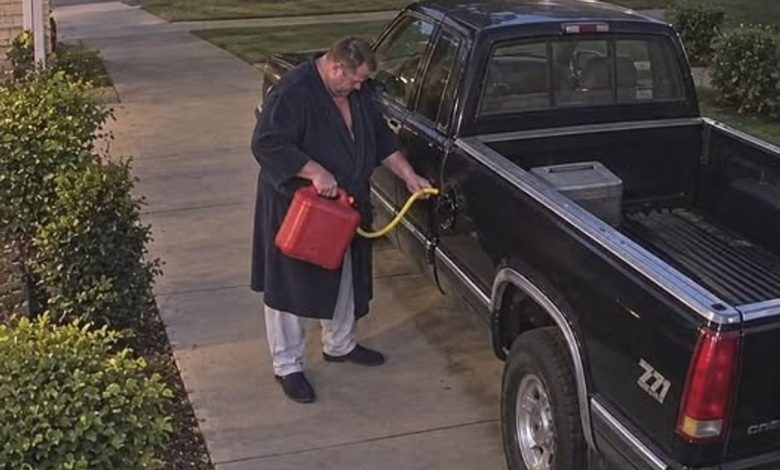
I sat at my kitchen table at four in the morning, holding my phone with both hands like it might slip away from me, watching a grainy black-and-white video of a man creeping up my driveway.
He moved slow. Careful. He looked back over his shoulder twice.
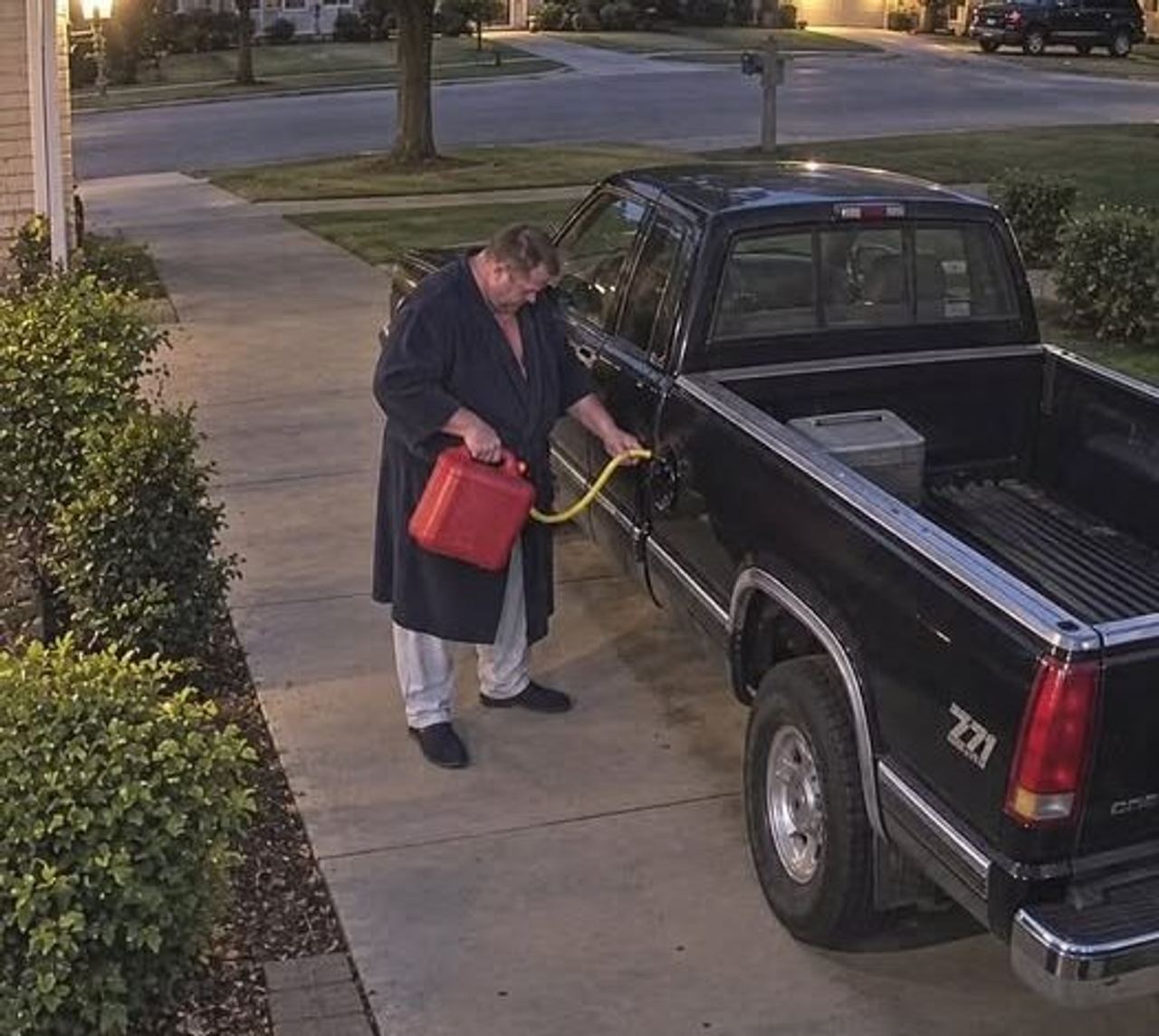
Then he knelt down beside my truck, pulled a hose out of his jacket, and fed it into my gas tank like he’d done it a hundred times before.
I watched him suck on that hose, spit, and start filling a red plastic can. The whole thing took him maybe four minutes. When the can was full, he stood up, screwed the cap back on my tank nice and neat so I wouldn’t notice, and walked back across the lawn to his own house.
I knew that walk. I’d seen it a thousand times.
I put the phone down and just sat there in the dark. My coffee had gone cold. My hands were shaking, and I told myself it was the cold, but it wasn’t.
I’m seventy years old. I’ve buried my wife. I’ve buried both my parents and most of my friends. I’ve had my heart broken more times than I can count, and I thought by now nothing could surprise me.
Let me back up, because you need to understand a few things first.
My name is Frank. I live alone in a small house at the end of Maple Court, a quiet little street in a quiet little suburb where nothing ever happens. Or at least that’s what I used to think.
My wife Ellen and I bought this house forty-one years ago. We raised our son here. We fought here and made up here and grew old here. She passed three years ago, in the spring, and the house has felt too big ever since. I keep the thermostat where she liked it. I still sleep on my side of the bed. Some habits don’t die just because the person does.
And then there’s the truck.
It’s a 1994 Ford pickup, faded blue, with a dent in the tailgate and a crack running across the corner of the windshield. It doesn’t look like much. I know that. People see it in the driveway and probably think it belongs to a man who can’t afford anything better.
But that truck and I have history.
Ellen and I bought it together back when our son was still in high school. We drove it to the lake every summer. We hauled lumber in it when we built the back deck. We drove it to the hospital the night Ellen’s mother had her stroke, and we drove it home from the funeral three days later, not saying a word the whole way.
When Ellen got sick at the end, I’d take her for drives in that truck because it was the only thing that still made her smile. She’d roll the window down and put her hand out in the wind like a teenager.
“This old thing,” she’d say, patting the dashboard. “It’ll outlive us both, Frank.”
She was half right.
So no, it’s not just a truck. When you get to be my age, the things you own start carrying the people you’ve lost. That truck is full of Ellen. Every scratch on it is a memory.
That’s why, when the gas started disappearing, it bothered me more than it should have.
It started on a Tuesday.
I remember because Tuesday is when I fill the tank. I’m a man of routine — you get that way when you live alone. I filled it up all the way at the Shell station on Hollis, forty-one dollars and change, and I drove home.
The next day I drove out to help my friend Walt fix a fence. Walt lives about ten minutes away and he’s got bad knees, so I go over now and then to do the things he can’t. We fixed the fence, drank two beers, complained about our backs, and I drove home.
Then I didn’t go anywhere. Thursday, Friday, Saturday — I stayed home. I mowed the lawn. I read. I watched some baseball. Normal days.
Sunday morning I got in the truck to drive to church, and I glanced at the gas gauge out of habit.
It was sitting just under half.
I stared at it for a second. That didn’t make sense. I’d barely driven anywhere. Ten minutes to Walt’s, ten minutes back. That’s nothing. That truck can go two weeks on a full tank the way I drive.
I tapped the gauge like an idiot, the way people do, as if tapping it would fix it. The needle didn’t move.
I figured I was losing my memory. It happens. My father got forgetful near the end, and I’ve been watching for the signs in myself, half-scared, the way you watch for a leak in a roof.
So I let it go. I told myself I must have driven more than I remembered.
But then it happened again.
The next Tuesday I filled up. Same station. Same routine. And that week I really paid attention. I wrote down every single time I drove the truck on a little notepad I keep by the phone. A trip to the pharmacy. A trip to the grocery store. That was it.
By Saturday, the tank was nearly empty.
I sat in the driveway with the engine running and the notepad in my lap, and I did the math three times.
There was no way. No possible way I’d used that much gas.
I’m not a man who scares easy, but I’ll tell you the truth — I got a little frightened. Not of a thief. That never crossed my mind. I got frightened of myself. I thought, this is it, Frank. This is how it starts. First you forget the gas. Then you forget where you parked. Then you forget your own son’s name.
I didn’t sleep well that week.
Finally I decided the smart thing to do was take the truck to a mechanic. If the gas was really vanishing, there had to be a leak. A crack in the tank, a bad fuel line, something. That would mean I wasn’t losing my mind. That would almost be good news.
So I took it to Dave’s Auto over on Cranston. Dave’s been fixing my vehicles for twenty years. He’s a big quiet man with grease worked so deep into his hands it’ll never come out.
“What’s the trouble, Frank?” he said, wiping his hands on a rag.
“My gas keeps disappearing,” I said. “I fill it up, I hardly drive it, and a few days later it’s half gone. I think there’s a leak somewhere.”
He raised an eyebrow. “Half gone? That’s a heck of a leak. You’d smell it. You’d see it on the ground.”
“I don’t smell anything. I don’t see anything. But it’s gone, Dave. I’ve been keeping track.”
He nodded slow. “All right. Leave it with me. I’ll put it up on the lift and take a good look.”
I left it there and Walt came and picked me up. I spent the whole day worried, imagining Dave calling to tell me the tank was rusted through, or worse, calling to tell me the truck was fine and the problem was between my ears.
He called around four.
“Frank,” he said, “I’ve had this thing up and down and inside out. I pressure-tested the tank, checked every line, every seal, every connection. There’s no leak. Nothing. This truck is in better shape than trucks half its age.”
I stood in my kitchen holding the phone. “There’s no leak?”
“None. Whatever’s happening to your gas, it’s not the truck.”
I thanked him and hung up, and I stood there for a long time.
If it wasn’t the truck, and it wasn’t a leak, then either I was losing my mind or somebody was taking my gas.
And that’s when Katie’s voice came into my head.
Katie is my granddaughter. My son’s girl. She’s twenty-four and she lives about an hour away and she calls me every Sunday whether I answer or not. She’s the kind of person who fixes everybody’s phones and computers at family gatherings. Ellen used to say Katie was born knowing things the rest of us would never understand.
A few months back, Katie had been after me about my house.
“Grandpa, you really should get a camera for the driveway,” she’d said. “They’re cheap now. It’ll email you if anything moves out there. Give you peace of mind.”
I’d waved her off at the time. “Nobody’s coming out here to bother me. Who’d want to rob an old man in a house full of junk?”
But now those words came back to me.
I called her that night.
“Grandpa!” she said, happy to hear from me on a day that wasn’t Sunday. “Everything okay?”
“I need one of those cameras,” I said. “The kind you were talking about. The driveway kind.”
There was a pause. “Grandpa, what’s going on?”
So I told her. About the gas. About Dave. About writing everything down and it still not adding up. She listened without interrupting once, which for Katie is a miracle.
When I finished, she said, quiet and serious, “Somebody’s stealing your gas, Grandpa.”
“I know so. Trucks don’t lose gas sitting in a driveway. Somebody’s coming at night. We’re going to catch them.”
She said “we” like she was going to drive over and sit in the bushes with me, and honestly, it made my chest feel warm in a way it hadn’t in a long time.
She ordered the camera that night. It came two days later in a small box, and Katie talked me through setting it up over the phone, step by step, patient as a saint while I fumbled with my glasses and cursed at the little screws.
“See the notch on the bracket, Grandpa? Line it up with the— no, the other way. There you go. Perfect.”
We aimed it right at the driveway. At the truck.
“Now we wait,” she said. “Check the footage every morning. And Grandpa?”
“Don’t go out there in the middle of the night to catch anybody yourself, okay? Promise me. Whoever it is, we do this smart.”
“I promise,” I said.
And I meant it. Mostly.
The first two nights, nothing happened. I checked the footage each morning and saw only the empty driveway, a cat crossing at 3 a.m., the wind moving the branches.
The third night, I got the man on the hose.
Now, I need to tell you about Clark, because a stranger stealing my gas would have been one thing. A stranger you can understand. Desperation, addiction, whatever. But Clark wasn’t a stranger, and Clark wasn’t desperate.
Clark moved in next door about six years ago with his wife Denise and their two kids. He’s maybe forty-five. He’s got a good job — something in sales, I never fully understood what, but he wears a nice watch and drives a newer SUV and takes the family to Florida every winter. They’re not rich, but they’re not hurting. Not by a long shot.
Clark’s problem isn’t money. Clark’s problem is that Clark is cheap. Bone-deep, shameless cheap. The kind of cheap that has nothing to do with what’s in your bank account and everything to do with what’s in your character.
I’d learned this the hard way over the years.
There was the ladder. Clark came over one Saturday, all smiles, and asked to borrow my extension ladder to clean his gutters. I said sure, of course, that’s what neighbors are for. Three months went by. I finally had to walk over and ask for it, and he acted like I was the strange one for wanting my own ladder back.
Then there was the pressure washer. Same story. He kept it half a summer. When I got it back, it was making a funny noise it never made before, and he swore up and down he hadn’t done anything to it.
The chainsaw. The wheelbarrow. My good set of socket wrenches, which I got back with two pieces missing. Every time, I had to be the one to come asking. Every time, Clark made me feel small for it, like a good neighbor would just let these things go.
And Ellen, God rest her, she’d always tell me to keep the peace. “Just let him have the wheelbarrow, Frank. It’s not worth a fight. We’ve got each other. We don’t need to be right.”
So I let a lot go. For her. Because she was soft that way, and I loved her for it, and after she was gone I kept letting things go because I felt like arguing with Clark would be arguing against her memory.
But this was different.
This wasn’t borrowing. This was sneaking onto my property in the dead of night and taking what was mine, over and over, and putting the gas cap back so I wouldn’t notice. This was a man looking at an old widower’s truck and deciding I was too tired, too retired, too invisible to fight back.
That’s the part that got me. Not the gas. The gas cost me maybe fifteen, twenty dollars a week. I could afford twenty dollars.
What I couldn’t afford was the idea that I’d become the kind of man people just take from. Like I was already halfway gone. Like the world had already decided I didn’t count for much anymore, and Clark was just the first one bold enough to act on it.
I watched that footage of him one more time. Watched him screw my gas cap back on so careful and neat. And something in me that had been asleep for three years woke all the way up.
I didn’t call Katie right away. I should have. But I was angry, and when I’m angry I do things my own way.
I put on my jacket and my shoes and I walked straight across the lawn to Clark’s front door, and I knocked. Hard. Three times.
It was early — maybe seven in the morning. I could hear the family moving around inside, kids getting ready for school, a TV going somewhere.
Clark opened the door in his work shirt, half a piece of toast in his hand, and when he saw me his face did something interesting. It flickered. Just for a second. He knew. Before I said a single word, he knew what this was about.
But he covered it fast.
“Frank!” he said, all cheer. “Little early, isn’t it? What can I do for you, buddy?”
I didn’t smile back.
“Have you been siphoning gas out of my truck?” I said. “Because I’ve got you on camera, Clark. I’ve got you on camera walking up my driveway at two in the morning with a hose. So don’t you stand there and lie to me. How dare you.”
The cheer fell off his face. But here’s the thing that told me everything about Clark. It didn’t fall into shame. It didn’t fall into an apology.
It fell into a laugh.
He actually laughed. A short, ugly little laugh, right in my face.
“Oh, come on,” he said. “Yeah, okay. I take a little. So what?” He leaned against his own doorframe like we were talking about the weather. “Have you seen gas prices lately, Frank? It’s highway robbery. And look — no offense — but you’re retired. You sit at home all day. You don’t even need the truck. Meanwhile I’ve got to get to work, I’ve got to get these kids to school, I’ve got a life to run. You’re not using it. I am. Where’s the harm?”
I felt my face go hot. “The harm is that it’s mine, Clark. It’s my gas. My truck. My money. You don’t get to decide I don’t need it.”
He rolled his eyes. Rolled his eyes, at a seventy-year-old man standing on his porch.
“God, you’re greedy, you know that?” he said. “It’s a couple of gallons. A couple of gallons! We’re neighbors, Frank. Neighbors are supposed to share. That’s how a community works. My father-in-law taught me that. But you—” he pointed the toast at me, “—you’d rather let it sit there in your tank than help out the guy right next door. That’s sad, honestly. That’s a sad way to live.”
I have been called a lot of things in seventy years. I have been in a war. I have lost a wife. I have carried coffins. And I will tell you that standing on that porch, being called greedy by a man in a fifty-dollar watch who’d been robbing me in my sleep, was one of the strangest, most upside-down moments of my whole life.
He’d twisted it. In his mind, he wasn’t the thief. I was the villain. I was the selfish one for wanting my own property.
“Clark,” I said, and my voice came out steadier than I felt, “you can’t steal from me. That’s not sharing. Sharing is when I say yes. You never asked.”
“Would you have said yes?”
“Well, there you go.” He shrugged, like I’d just proved his point. “Look, I gotta get the kids to school. We’ll talk about it later, okay? Have a good one, Frank.”
And he shut the door.
He shut the door in my face.
I stood there on his porch for a good ten seconds, staring at the closed door, listening to a kid inside ask, “Who was that, Daddy?” and Clark saying, “Nobody, bud. Just the neighbor being weird.”
I walked home. I made a fresh pot of coffee. And I sat down at my kitchen table to think, because I knew one thing for certain now.
This was not going to end with a conversation.
My first instinct, I’ll be honest, was to call the police.
I even picked up the phone. I had it right there. It’s theft. It’s plain, provable theft, and I had it on video, in color, timestamped. Any officer in the county would take one look and Clark would be sitting in a cruiser by lunchtime.
But I put the phone back down.
I thought about how it would go. The police come. They talk to Clark. Maybe they write him a ticket, maybe they don’t. He’s got a clean record, a nice house, two kids. Best case, he pays a fine and gets a slap on the wrist. And then what?
Then I have to live next to him. For years, maybe. Him and his wife and his kids, right there over the fence, hating me, glaring at me, telling everyone on the street that the crazy old man next door called the cops over a couple of gallons of gas.
Because that’s the thing about a man like Clark. He’d never see himself as the thief. He’d see himself as the victim. And he’d make sure everyone else saw it that way too.
Police was too clean. Too easy. And it wouldn’t teach him a single thing.
No. If I was going to do this, I wanted Clark to understand, right down in his bones, exactly what it feels like to be caught. I wanted him to feel small and stupid and exposed the way he’d tried to make me feel small.
But I didn’t want to hurt him. I want to be clear about that. I’m not a violent man. I didn’t want to damage his car or put anything in his tank or do anything that could get somebody hurt. That’s not justice. That’s just becoming him with a different face.
I wanted to embarrass him. Publicly. I wanted the whole street to see who Clark really was underneath the nice watch and the Florida tan.
So I called Katie back and told her everything.
She was quiet for a long time when I finished. Then she said, “Grandpa. He shut the door in your face?”
“He called you greedy?”
I heard her let out a long breath. “Okay. Okay. We are not calling the police.” My twenty-four-year-old granddaughter, suddenly sounding like a general. “The police is what he’d expect. And it lets him play the victim. No. We’re going to be smarter than that.”
“That’s exactly what I was thinking.”
“I’m coming over this weekend,” she said. “Don’t do anything until I get there. Promise me, Grandpa. For real this time.”
I promised. And this time I kept it.
Katie showed up Saturday morning in her little dented car, hauling a duffel bag like she was moving in. She hugged me tight in the doorway, and she smelled like Ellen’s shampoo — the same brand, I found out later she uses it on purpose — and I had to blink a few times before I let her go.
We sat at the kitchen table with coffee and a notepad, and we planned it out like we were planning a bank job.
“First,” Katie said, “we need proof he can’t wriggle out of. We’ve got the camera footage, but I want more. I want it airtight.”
“It’s pretty clear,” I said.
“It needs to be clear to everybody, not just us. Trust me.” She was tapping her pen against the pad. “Second — the actual thing. The consequence. It’s got to embarrass him, it can’t hurt him, and it has to happen where people can see it. That’s the whole point. Clark only cares about how things look. So we hit him right there.”
I nodded slow. She was smart, this girl. Smarter than her old grandfather.
“I’ve got an idea,” I said. “But it’s a little strange.”
“Strange is good. Tell me.”
So I told her.
Over the years, Ellen and I had done a lot of little craft things around the holidays. She liked to make her own dyes for Easter eggs, the old-fashioned way, and she had a whole shelf in the garage of powders and concentrates. Some of that dye was industrial-strength stuff, the kind that turns your hands blue for a week if you’re not careful. I’d learned that the hard way one Easter and gone to church on Sunday with hands the color of a robin’s egg.
There was also, sitting in a box in that same garage, a case of prank stink spray my son had given me years ago as a gag gift. Some awful concentrated skunk-smell stuff, completely harmless, but it clings to everything and it is genuinely, powerfully foul. We’d never used it. Ellen thought it was disgusting. It had just sat there.
“Here’s what I’m thinking,” I said. “Clark comes at night. He siphons my gas into that red can of his. What if the can he siphons into isn’t the problem — what if the surprise is waiting for him someplace else. Someplace he’ll open it in front of the whole neighborhood.”
Katie’s eyes were getting wider. “Grandpa. Where are you going with this.”
“His porch,” I said. “In the morning. When everyone’s out.”
And I laid it out for her, and by the end she was grinning so wide I thought her face would split.
“Okay,” she said. “Okay. That’s evil. That’s beautiful. But we do it my way, so it’s tight. And we document everything, so if he ever tries to spin it, we’ve got the receipts.”
We spent the rest of that day getting ready.
Here’s what we did.
First, Katie downloaded every scrap of the camera footage — not just the one clean night, but three separate nights she found where Clark came and did his business. Three nights, three timestamps, three angles of the same man robbing the same truck. She saved copies to about four different places. “Airtight,” she kept saying. “Airtight.”
Then she did something clever I never would have thought of. She made a second little camera setup, a tiny hidden one, and we aimed it not at my truck but at Clark’s front porch. “For the finale,” she said. “We’re going to want to remember this.”
Then came the fun part.
We took the world’s most ordinary cardboard box. A gift box, the kind you’d put a nice sweater in. We lined the inside with a heavy plastic bag so nothing would leak through the bottom. And inside that, we packed it full.
We mixed up Ellen’s industrial blue dye into a thick, gloppy paste — bright, electric, permanent blue. We poured that in. Then Katie, wearing rubber gloves and holding her breath, added the stink spray. Several bottles of it, cracked open and nestled down in the goop. The smell that came out of that box, even sealed, was enough to make your eyes water from across the garage.
On top of all that, we placed a single sheet of paper, folded neat. And on the paper I’d written, in big block letters so there’d be no mistaking it:
THIS IS WHAT YOU’VE BEEN TAKING FROM ME EVERY NIGHT. NOW EVERYONE KNOWS. — YOUR GREEDY NEIGHBOR, FRANK.
And clipped to the paper were three printed stills from the footage. Clark, kneeling by my truck. Clark, with the hose in his mouth. Clark, walking back across the lawn with the full can, plain as day, his face lit up clear by the streetlight.
We wrapped the box in cheerful birthday paper. Bright colors. A bow on top. Because that was the whole trick, you see. It had to look like a gift. It had to make Clark curious. It had to make him open it himself, out on his porch, in front of God and everybody, instead of just kicking it aside.
We taped the box shut but left the lid so it would pop open easy the second he pulled the ribbon.
We finished a little after dark. Katie stood back and looked at our handiwork and shook her head slow.
“Grandpa,” she said. “Grandma would’ve loved you for this.”
“Grandma would’ve told me to let him have the gas,” I said.
Katie smiled. “Yeah. But she’d have loved you for it anyway.”
Now, the timing had to be right.
We didn’t just set the box out that night. That would’ve been too soon, and Clark might’ve opened it alone in the dark. No. We waited.
We waited until the next time Clark came for my gas. Because I wanted him to have done it fresh. I wanted him to have that red can full of my gas sitting in his garage when the whole thing came down. That felt right to me. That felt like the circle closing.
It took two nights.
On the second night, a little after two in the morning, my phone buzzed on the nightstand. The camera. Motion in the driveway.
I got up. I didn’t turn on the lights. I stood at my bedroom window in my undershirt and watched the real thing with my own eyes for the first time.
There he was. Clark. Kneeling by my truck like it was his own. Feeding the hose in. Filling his can.
Part of me wanted to throw open the window and yell. But I didn’t. I just watched, and I felt calm. Calmer than I’d felt in weeks. Because I knew something Clark didn’t.
Tomorrow was going to be different.
He finished, capped my tank all neat and tidy like always, and walked home with my gas.
I texted Katie one word: Tonight.
She was staying in the guest room. She texted back a thumbs up and a single word of her own: Showtime.
We set the box on Clark’s porch at 6:45 the next morning.
I did it myself. Katie wanted to, but I told her no — this was mine to do. I walked across that lawn in the gray morning light, my heart going like a drum, and I set that bright wrapped box right in the middle of Clark’s welcome mat, dead center, bow up, where he couldn’t possibly miss it on his way out to work.
Then I walked back home, and Katie and I sat on my front step with two cups of coffee and waited.
It was a beautiful morning, actually. Cool and clear. Birds goi…
Read more stories
- The Restaurant Manager Stole My 70th Birthday Terrace for a VIP—48 Hours Later, He Begged Me to Stop
- The Little Girl on the Swing Who Found a Family Emma’s Promise!
- Firing Me After Eighteen Years Triggered A Secret Clause In His Will
- When Something Precious Is Damaged How Patience Can Lead to Restoration