They Mocked His Crutches, Not Knowing His Marine Father Was Watching. What Happened Next Changed the Whole School
Chapter 1: The Weight of Gravity
The blacktop at Redwood Elementary shimmered under the June sun. The air smelled like hot rubber, sunscreen, and the sweet stickiness of spilled juice. It was the last Friday before summer break. Kids moved in loud, excited waves, counting down minutes to freedom.
For ten year old Leo, the playground felt different. It was not freedom. It was a map of risks, angles, and exits. Every step needed planning. Every pause invited attention. And attention was the last thing he wanted.
Leo’s forearm crutches pressed into his palms as he worked through the rhythm that helped him move: lift, swing, plant, step. Cerebral palsy made his legs stubborn, like they spoke a different language than his mind. He had learned to negotiate with gravity every single day.
“Move it. You’re blocking the lane.”
Leo knew the voice without turning. Tyler Van Doren. The boy with perfect sneakers and a perfect grin that never reached his eyes. Tyler had friends who laughed when he laughed, even when nothing was funny.
Leo kept his eyes forward. “I’m moving,” he said quietly.
Tyler slid in front of him anyway, cutting him off. Three other boys fanned out like a wall, leaving Leo with no clean path around them.
“You’re too slow,” Tyler said, loud enough for other kids to hear. “Those crutches should come with a warning label. Hazard on the road.”
Leo swallowed hard. He tried to breathe normally. Just get to the bus loop, he told himself. Do not react. Do not give him the moment he wants.
Tyler tipped his head and kept going. “My dad says the town wastes money on stuff like that. Says people like you slow everybody down.”
Heat rushed into Leo’s cheeks. He hated how his body always betrayed him first, the flush, the trembling, the tightness in his chest. “My dad paid for these,” he said, trying to keep his voice steady.
Tyler’s smile sharpened. “Your dad?” he said, as if the words tasted bad. “My dad says he’s probably not even around. Maybe he ran off. Maybe he just couldn’t handle having a disabled kid.”
That sentence landed like a punch, not to the face, but somewhere deeper. Somewhere that had been sore for months.
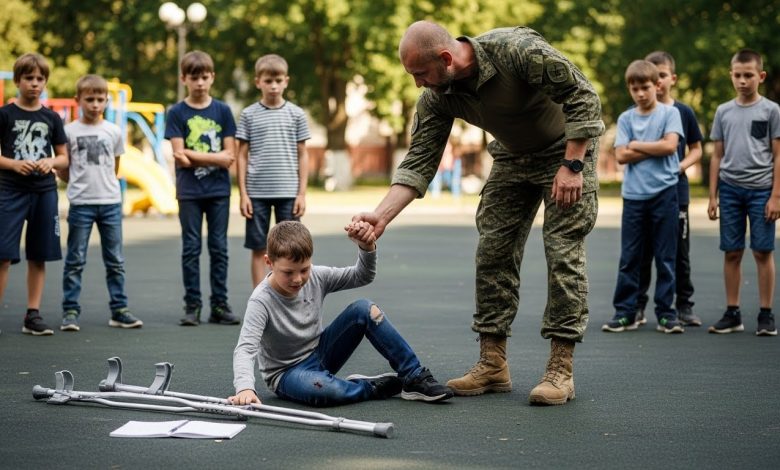
Leo tried to step around Tyler. Anger made his movement uneven, hurried, less controlled. His right crutch swung wider than it should have. For half a second, his balance slipped.
Tyler noticed. He did not shove Leo. He did something smaller, quicker, harder to explain. A foot hooked behind Leo’s brace, and suddenly Leo’s support was gone.
Leo fell.
The impact stole his breath. His hands scraped against the hot asphalt. His crutches clattered away and rolled out of reach. The worst part was not the pain. It was the sound of laughter, and the sight of his backpack spilling open.
His sketchbook slid out and landed face down in a puddle of grape juice, soaking up purple like a bruise.
“Oops,” Tyler said, pretending to sound sorry. “Gravity still works, huh?”
Leo forced his eyes shut. He could feel tears gathering and he hated that too. He reached for his nearest crutch.
Tyler kicked it farther away.
“Go on,” Tyler murmured. “Fetch.”
Chapter 2: The Shadow That Stopped the Noise
Leo pushed up to his hands and knees. The asphalt pressed rough against his skin. He reached toward his sketchbook first, like he could rescue the drawing before it was ruined.
A recess monitor stood far off near the building, half watching, half scrolling on her phone. She called out without moving closer, “Hurry up! Buses leave soon!”
Tyler’s friends snickered again. Tyler lifted his foot, aiming toward the soaked sketchbook. Leo flinched, bracing for the sting of another humiliation.
But the moment never landed.
The air changed.
It started as a quieting, like someone turned down the volume on the entire playground. A ripple of silence rolled inward from the curb and across the blacktop. Kids stopped moving. Voices died mid sentence. Even Tyler froze with his foot half raised.
A man stood a few steps away.
He was tall and broad, dressed in dusty camouflage. A heavy duffel bag hung from one shoulder. His posture was calm, but there was something in the stillness that made everyone instinctively step back.
“Put your foot down,” the man said.
His voice was not loud. It was steady, low, and absolute. The kind of voice that did not need to shout to be heard.
Tyler’s foot dropped to the ground. His confidence drained from his face in real time.
The man lowered his duffel bag. It hit the ground with a heavy thud.
Then he walked forward, and the crowd parted without being asked.
He knelt beside Leo.
Leo looked up, blinking against tears and sunlight. The man removed his dark sunglasses, and Leo saw eyes that looked exhausted and alert at the same time. Eyes that carried distance and weight, but also something tender that broke through the hardness.
“I’m here, Leo,” the man said softly. “I’m home.”
Leo’s throat tightened. “Dad?”
Sergeant First Class Mark Daniels cupped his son’s face gently, like Leo was something precious and fragile. His hands were rough, the hands of someone used to carrying heavy things, yet he moved with care. He checked Leo’s scraped palms, his torn jeans, the bleeding knee. Then his gaze fell on the sketchbook in the purple puddle.
Mark stood slowly and turned toward Tyler.
Tyler took a step back. His friends had already melted into the crowd. For the first time, Tyler looked alone.
“I was just helping him,” Tyler tried, voice too high, too fast.
Mark did not argue. He simply asked one question, calm as stone. “Leo, did you fall?”
Leo pushed himself upright, gripping his father’s hand for balance. He looked at Tyler. He looked at the circle of kids watching. Then he spoke, small but clear.
“No,” Leo said. “He kicked me.”
Mark nodded once. No drama. No yelling. Just a decision made in his eyes.
“Pick them up,” Mark said to Tyler. “My son’s crutches. And his book.”
Tyler hesitated, searching for his usual shield, searching for a way out. There was none. He moved, stiff and embarrassed, and gathered the crutches first. Then the sketchbook, sticky and soaked. He handed them over without making eye contact.
Chapter 3: The Adults Who Looked Away
The recess monitor finally approached, breathless and flustered, talking about campus rules and “no trespassing.” But her words sounded thin against what everyone had just witnessed.
Mark held up the wet sketchbook, not as a weapon, but as evidence of what neglect looks like when it wears a grown up face.
“You were right there,” Mark said quietly. “You saw what happened.”
The monitor tried to answer. No explanation came out that made sense.
Mark shifted his focus back to Leo. He steadied the crutches in Leo’s hands and checked that his son was stable.
“Can you walk to the truck?” Mark asked. “Or do you want me to carry you?”
Leo straightened as much as he could. His knee hurt. His palms stung. His chest still felt tight. But something inside him stood up too.
“I can walk,” Leo said.
Mark placed a firm, comforting hand on his shoulder. “Lead the way. I’m right here.”
They walked through the silent crowd. No one laughed. No one whispered. Tyler stayed behind, frozen in the spot where power had finally failed him.
Chapter 4: The Diner and the Fear No One Said Out Loud
Daisy’s Diner smelled like bacon grease, sanitizer, and cheap coffee. Elena Daniels moved through the lunch rush with a practiced smile that did not reach her tired eyes. Double shifts had become normal. Sleep had become optional.
The bell above the door chimed.
“Sit anywhere,” Elena called without looking up. “I’ll be right with you.”
Something in the room shifted. A hush. A pause. She turned, coffee pot in hand, and the pot slipped from her fingers.
It shattered on the floor. Dark liquid spread across the tiles. Elena did not move. She did not even look down.
Mark stood in the doorway.
He looked rough, sunburned, worn down. But he was there. Real. And beside him stood Leo, gripping his crutches, standing taller than he had that morning.
“Mark?” Elena whispered, like saying his name too loud might break him into smoke.
Mark stepped forward. “I’m sorry I’m late,” he said, voice thick. “I’m here.”
Elena ran to him and held on like the world had been tilting for months and finally found its balance again. Leo smiled, the kind of smile that arrives after too much waiting.
Chapter 5: Power Tries to Take Back Control
Outside, the warmth did not last.
A black luxury SUV blocked Mark’s old truck in the parking lot. A man in a tailored suit leaned against the hood, checking his watch like he owned the air.
Richard Van Doren.
He spoke with a smooth confidence that felt rehearsed, the kind of confidence that comes from never facing consequences.
He talked about his son. About “misunderstandings.” About connections and influence. He tried to turn a moment of accountability into a threat wrapped in polite words.
Mark listened without raising his voice.
When Richard hinted at legal trouble and pressure, Mark responded with something simpler.
“Stay away from my family,” Mark said, calm and clear. “We are done with this.”
Chapter 6: A Long Night and a Small Voice That Refused to Stay Quiet
The hours that followed were heavy. Fear has a way of making even familiar rooms feel smaller.
Leo watched his mother at the kitchen table, surrounded by paperwork and worry. He looked at his sketchbook, still stained, still imperfect.
He set up a tablet camera, took a breath, and recorded a message. He did not exaggerate. He did not insult. He simply told the truth, as a child who had been hurt and wanted to be seen.
He posted it.
He did not know what would happen.
By morning, people had shared it. Commented. Supported. Neighbors who had stayed quiet for months finally spoke. Veterans, parents, teachers, and community members demanded fairness.
Chapter 7: Truth Has a Way of Gathering People
When the school board meeting came, the room was packed. Cameras lined the walls. Parents stood shoulder to shoulder. The air felt charged, not with anger, but with resolve.
Mark arrived dressed formally, composed and steady. Elena and Leo walked beside him.
In the room, the same story repeated in different faces: people who had been ignored, people who had been dismissed, people who were finally refusing to look away.
Mark spoke about strength. Not the strength of intimidation, but the strength of getting up after being knocked down. He spoke about his son’s daily battles, and how those battles deserved respect, not cruelty.
He did not ask for pity.
He asked for decency.
Epilogue: Unbroken
Two weeks later, the sun still burned hot on the playground, but the air felt different. Lighter. Safer.
Leo stood near the edge of the grass, crutches planted firmly. His sketchbook had dried. The purple stain remained, not as damage, but as proof that he had lived through the moment and kept going.
Tyler approached alone, without his usual audience. He looked down, then back up, struggling to speak like a regular kid again.
“I saw your drawing,” he said quietly. “It’s actually… really good.”
Leo studied him for a beat. “Thanks,” Leo said.
Tyler swallowed. “I’m sorry,” he mumbled. “About everything.”
Leo did not offer instant friendship. Some things take time. But he offered something real.
“Okay,” Leo said. “See you in September.”
Tyler nodded and hurried away.
Leo turned toward the parking lot. His father waited beside an old truck, smiling like a man who had finally made it back to what matters. Mark opened the passenger door as if it was the most important duty in the world.
“Ready?” Mark asked.
Leo climbed in and pulled out a fresh, clean sketchbook. He opened it to a new page and held his pencil like a promise.
“Let’s get ice cream,” Leo said. “I’ve got a new hero to draw.”
Mark smiled. “Sounds like a plan.”
And they drove forward, leaving the long shadow of that day behind them.