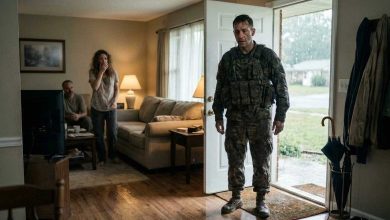
No Honor Guard Came To My Vietnam Vet Dad’s Funeral So Bikers Folded His Flag
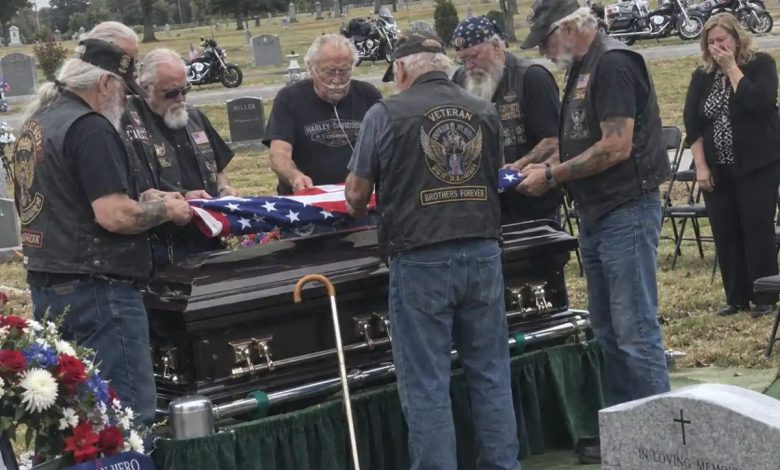
Six old bikers I’d never met folded my dad’s flag because the Army sent nobody.
I’d called the number on the VA paperwork three times that week. They said the honor guard request was “in process.” My dad had been dead for nine days.
He did two tours in Vietnam. Came home in 1970 to a bus station in Toledo where nobody was waiting. Spent the next fifty years never once talking about it, not even to Mom.
The funeral home told me they’d play a recording of Taps from a speaker if nobody showed. A recording. For a man who carried a piece of shrapnel in his hip until the day he died.
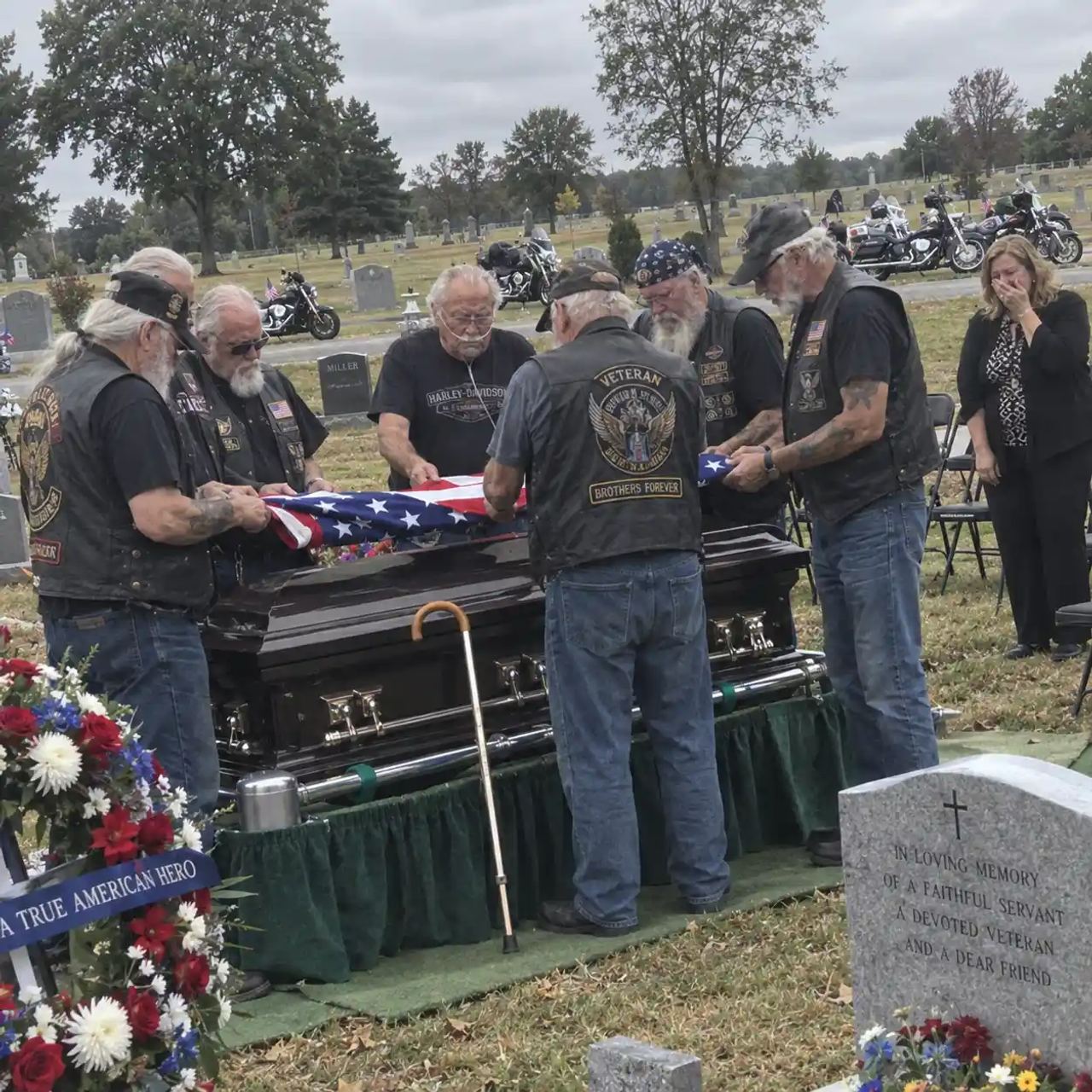
I was standing by the casket at 9:40 in the morning, twenty minutes before the service, when I heard the bikes. Six of them. They pulled into the cemetery slow, like they knew exactly where they were going.
Every one of them had gray hair. One walked with a cane. Another had an oxygen tube running under his nose and a Harley shirt tucked into his jeans.
They didn’t say a word to me at first. They just lined up on both sides of the casket like they’d done it a hundred times before.
The one with the cane stepped forward and pulled a folded flag out of a canvas bag. Not a new one. This flag was faded, with a brown stain along one edge and a small hole near the stars.
“Ma’am,” he said, “this isn’t the flag the government’s going to give you. This one’s his.”
I said I didn’t understand. My dad never had a flag. He never went to a single reunion. He never wore a hat or a pin or anything.
The old man looked at the other five. Then he looked back at me and pulled a photograph out of his wallet. Seven young men in front of a helicopter, 1969, all of them grinning.
“There’s six of us here,” he said. “Your daddy made seven. This flag came off the pole at a firebase called Mary Lou, the morning after he pulled every one of us out of a burning Huey.”
I didn’t say anything. I couldn’t.
“That stain is his blood,” the man said. “That hole is where the piece of metal went through before it went into him. He carried Eddie Kowalski out on his back with that flag wrapped around Eddie and never put him down. Not once. Not even after he got hit.”
He handed me the photograph. I looked at the seven faces. My father was the one on the far left, nineteen years old, skinny, with a cigarette behind his ear. I had never in my life seen him smile like that.
“Who’s Eddie?” I asked.
“Eddie took the picture,” the man said.
The pastor came over, confused, looking at me for permission. I nodded. I didn’t know what I was nodding at, but I nodded.
The six of them took their places again. Three on each side. The one with the oxygen tube unclipped it from his nose and let it hang. He pulled a dented brass bugle out of a saddlebag on his bike and walked to the head of the casket.
The funeral director had his phone out, ready to play the recording. The man with the cane looked at him and shook his head one time. The director put the phone away.
The pastor read what he had to read. I didn’t hear a word of it. I was watching the old men. None of them cried. They stood so still that a sparrow landed on the casket rail next to one of them and he didn’t even blink.
Then the one with the cane said, “Detail. Present arms.”
Six men in their seventies snapped their hands to their brows like they were twenty. The one with the cane dropped it in the grass to do it. He stood on his own the whole time. I found out later he hadn’t stood without that cane in six years.
The bugler played Taps. He missed two notes. His lungs weren’t what they used to be and you could hear him fighting for air on the long ones. I have heard Taps played perfectly by young men in white gloves at other funerals. I would not trade this one for any of them.
When he finished he clipped the oxygen back on his nose and stepped back into line.
Two of them lifted the old flag and unfolded it. They laid it across the casket and smoothed it flat with their hands. Then they folded it. Slow. Thirteen folds. Their hands shook. One of them got a fold wrong and the man across from him fixed it without a word and they kept going.
The man with the cane picked it up off the grass, walked to me, and went down on one knee. I heard the knee pop.
“On behalf of six men who wouldn’t be here without him,” he said, “and one who is.”
He put the flag in my hands. I sat down in the chair behind me because my legs quit.
His name was Hal Pruitt. He was seventy-seven years old and he’d ridden nine hours from Chattanooga on a Road King with a bad hip and two busted vertebrae.
The others were Del from Kentucky, Marcus from Dayton, the bugler was Sonny from outside Pittsburgh, and the two quiet ones in the back were brothers, Ray and Tommy Bishop, from Indiana. They’d all been in the same platoon. Eighteen months in, seven of them plus Eddie Kowalski were riding in a Huey that took a rocket through the tail boom.
Hal told me the story at the diner afterward. I asked them to come. They didn’t want to intrude. I said if they left I’d never forgive myself, so they came.
The Huey went down in elephant grass and caught fire. The pilot and the crew chief died on impact. The rest of them were tangled up in the wreck, some unconscious, some pinned. My father was thrown clear.
“He should’ve run,” Hal said. “Anybody would have. The thing was already burning and we were taking fire from the treeline.”
He didn’t run. He went back in six times. He dragged Hal out by the collar. He carried Sonny across his shoulders. He pulled Del’s leg free with a tire iron from the door gun mount. He went back for the Bishop brothers together because they wouldn’t let go of each other.
Eddie was last. Eddie was the worst hurt. Eddie had been closest to the tail.
“Your dad wrapped him in that flag because Eddie was bleeding out and there was nothing else to wrap him in,” Hal said. “Firebase Mary Lou was two clicks west. Your dad walked it. He carried Eddie the whole way with the rest of us limping behind.”
“Did Eddie make it?” I asked.
Hal shook his head. “He died about a hundred yards from the wire. Your dad didn’t know. He kept talking to him the whole way. Telling him about Toledo. Telling him about a girl named Carol he was going to marry when he got home.”
Carol was my mother.
“Halfway there your dad took shrapnel in the hip from a mortar round,” Hal said. “Went right through the flag first. He went down on one knee and he got back up. Nobody could make him put Eddie down. When we got inside the wire two medics had to pry Eddie off his back.”
The graves registration people wanted the flag. It was a government flag. My father told them no. Hal said it was the only time he ever heard my father raise his voice.
“They let him keep it,” Hal said. “I think they were scared of him.”
I asked the question I’d been holding since the cemetery.
“Why did he never tell me?”
The six of them looked at each other. Del answered. He was the one who’d gotten the fold wrong.
“He never told anybody. Not us either. When we got home he shook our hands at the airport in Oakland and said ‘Take care of yourselves’ and that was it.”
They’d tried to find him. For years. Before the internet it was phone books and letters to the VA. Marcus finally got an address in 1994 and they all wrote him.
“He wrote back one time,” Hal said. He pulled a folded piece of paper out of his wallet, the same wallet the photograph came from. The paper was soft as cloth from being opened so many times.
The letter was three lines in my father’s handwriting.
Hal. I’m glad you’re all alive. I’m not that person anymore and I can’t be him again. Please don’t write. R.
“So we didn’t,” Hal said. “We respected it. Thirty-two years.”
“Then how did you know he died?”
Sonny laughed, wheezing. “Honey, we’re old. We read the obituaries every single morning. All of us. Every paper in every town we ever heard him mention. I’ve been reading the Toledo Blade online for twenty years. Never missed a day.”
He’d found the notice last Wednesday. He called Hal. Hal called the rest. They didn’t discuss it. Nobody asked if they were going. They just each said what time they’d leave.
“Sonny’s doctor told him he couldn’t ride,” Del said.
“Sonny’s doctor can kiss my ass,” Sonny said.
Tommy Bishop, who hadn’t said a word all morning, reached across the table and put his hand on mine. His fingers were cold and rough as rope.
“We made a promise,” he said. “The night after Mary Lou. We were sitting in the aid station and your dad had that flag balled up in his lap with Eddie’s blood on it and his own blood on it and he wouldn’t let anybody wash it. And Hal said, ‘Whichever one of us goes first, the rest of us fold that over him.’ And we all said yes.”
“He kept the flag,” Hal said. “We figured he’d be the one folding it over one of us someday. Didn’t work out that way.”
“So he gave it to you?”
“He mailed it to me in 1994,” Hal said. “Same week as the letter. No note. Just the flag in a box. I think it was his way of saying he was still in on the promise even if he couldn’t be in on anything else.”
I want to tell you about the man I knew, because the man they knew was a stranger to me.
My father worked thirty-one years at the Jeep plant. He was quiet. He was not cruel and he was not warm. He fixed things around the house and he watched the Tigers and he went to bed at nine. He had a limp he said came from a forklift.
When I was eleven I asked him about the war for a school project. He said, “There’s nothing to say about it,” and went outside to the garage. He stayed out there until after I was asleep.
He never went to the Fourth of July parade. He left the room when the national anthem played on TV. When a neighbor’s kid came home from Iraq and the whole street put out flags, my father’s house was the only one without one. People talked. I was ashamed of him for it. I’m ashamed now that I was ashamed.
I thought he was cold. I thought he didn’t care. I spent my whole adult life thinking my father was a man who didn’t feel anything.
He carried a dying boy two kilometers with a piece of metal in his hip and talked to him about my mother the entire way.
He wasn’t cold. He was full. He was so full of it that he had to close every door he had just to keep it from spilling out.
The six of them stayed for three days.
They wouldn’t take a hotel. They slept on my floor and my couch and Del slept in his truck. Hal’s back couldn’t take the floor so I gave him my bed and slept in the chair.
They helped me clean out the house. That’s a thing nobody tells you about death. Somebody has to go through the drawers.
We found the medals in a coffee can in the garage, behind the paint. A Bronze Star with a V. A Purple Heart. Something else Hal said was a Silver Star that my father had never picked up because he skipped the ceremony.
“He was in the hospital in Japan for the hip when they cut the orders,” Hal said. “Never went to get it. I don’t think he wanted it.”
We found something else too. In the closet in his bedroom, behind the winter coats, was a shoebox. Inside were thirty-two envelopes, one for every year since 1994.
They were addressed to Hal. Stamped. Sealed. Never mailed.
Hal sat on the edge of my father’s bed and opened the first one. He read it and passed it to Sonny and Sonny read it and passed it to Del. They went around the room like that with every letter. Nobody spoke for an hour.
I read the last one. It was dated this past March.
Hal. I’m sick now and I probably won’t write again. I want you to know I read every one of the obituaries too. I check on you boys every morning. I’m glad none of you have gone yet. I hope you’re all still riding. I hope somebody folds it right. I’m sorry I couldn’t be better than this. Tell Eddie I’m coming. R.
Hal folded it up and put it in his wallet with the photograph and the three-line letter from 1994.
“He was checking on us,” Sonny said. His oxygen was hissing. “Every morning. Same as us.”
“Thirty-two years,” Del said. “Same damn thing. Both directions.”
Ray Bishop, the other quiet brother, said the only thing I ever heard him say all week.
“Stubborn son of a bitch.”
Everybody laughed. I laughed so hard I cried, and then I just cried, and Hal put his arm around me and let me.
They left on a Friday morning.
I tried to give the flag back. I told Hal there were still six of them and the promise wasn’t done and one of them would need it.
He wouldn’t take it.
“The promise was whoever goes first,” he said. “He went first. It’s done its job. It’s yours now.”
“What about the rest of you?”
“The rest of us,” Hal said, “are going to get folded up in some brand new government flag by some kid in white gloves who never heard of us, and that’s fine. That’s how it’s supposed to be. Your dad’s the only one who ever earned that one.”
Sonny hugged me. He smelled like motor oil and menthol. “You call any one of us,” he said. “Any hour. You’re his. That makes you ours.”
They pulled out one at a time. Hal went last. He sat on the bike for a minute in my driveway with the engine running and looked at the house.
“You know what he said to me?” he yelled over the engine. “At the airport in Oakland, 1970. Last thing he ever said to my face. He said, ‘Nobody’s going to be waiting for us, Hal. Nobody’s going to be at the gate. So we’d better be there for each other.’”
Then he pulled out and rode off and I stood in the driveway until I couldn’t hear him anymore.
The VA called on Monday. A nice young woman apologized for the delay and said the honor guard could be available the following Thursday if I wanted to reschedule the graveside service.
I told her thank you, but somebody had already taken care of it.
She asked who.
I looked at the flag on my kitchen table, faded and stained, with a hole near the stars that went through it and into my father before I was ever born.
“His friends,” I said. “They were waiting for him.”
In 1970 my father got off a bus in Toledo and nobody was there.
In 2026 he got to the cemetery and six old men were already standing at the casket.
I think it took him fifty-six years, but I think he finally made it home.